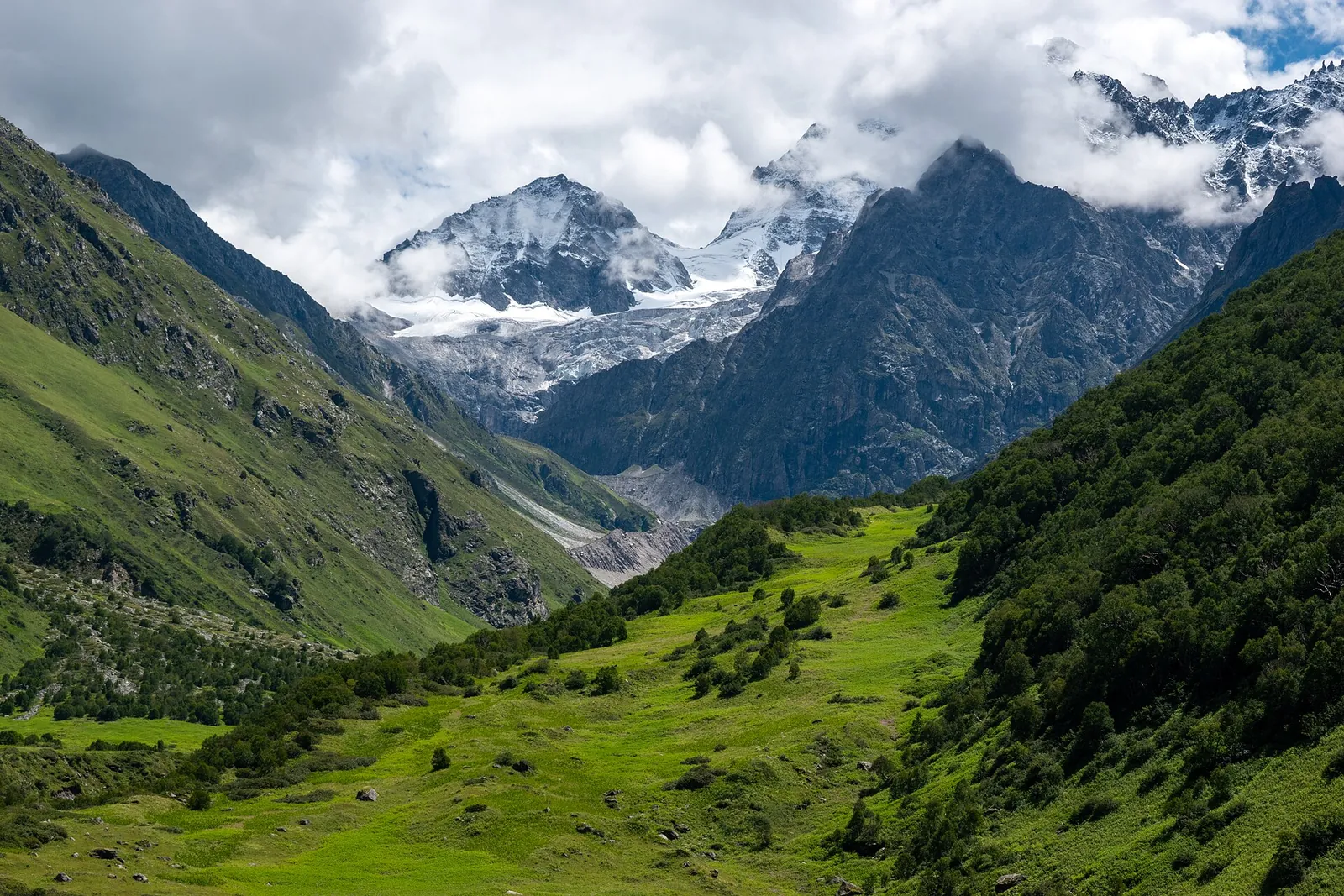
The usual story is short: a British mountaineer got lost in 1931, stumbled on a hidden valley and named it. The real history is longer and more interesting. The people of Bhyundar knew the valley and grazed their animals in it until 1982, mountaineers had crossed into it decades before 1931, and its fame as a garden owes as much to a botanist who died there in 1939, and to the Indian scientists who surveyed it later, as to the man who named it. This page sets out the history in order, from local legend to World Heritage Site, and says plainly where the records disagree.
Last checked 18 October 2026
Timeline at a glance
| When | What happened |
|---|---|
| Long before 1900 | Known to Bhyundar villagers as part of their valley, used for grazing and plant gathering, and woven into local legend |
| 1862 | Colonel Edmund Smyth is credited in some timelines with reaching the Pushpawati valley. We could not trace the original record |
| 1907 | Bruce, Mumm and Longstaff make the first recorded crossing of the Bhyundar Khal pass into the valley |
| July 1931 | Frank Smythe, Eric Shipton and R. L. Holdsworth cross into the valley on their way back from the first ascent of Kamet |
| 1936 to 1937 | Sikh pilgrims identify Lokpal lake above Ghangaria as Hemkund, and a small gurdwara is built on its shore |
| 1937 | Smythe returns for about six weeks of the monsoon to explore and collect plants and seeds |
| 1938 | Smythe publishes The Valley of Flowers |
| 4 July 1939 | Botanist Joan Margaret Legge dies in a fall while collecting plants in the valley |
| 1950s and 1960s | Botanists from the Botanical Survey of India study the valley's flora |
| 6 September 1982 | Declared a national park under the Wildlife (Protection) Act, 1972. Livestock grazing ends |
| 1987 | The Botanical Survey of India publishes a botany of the park and its surroundings |
| 1988 | Neighbouring Nanda Devi National Park becomes a World Heritage Site. The Nanda Devi Biosphere Reserve is created |
| From 1993 | Ecologist Chandra Prakash Kala begins a decade of surveys and lists about 520 plant species |
| 2000 | The valley becomes a second core zone of the Nanda Devi Biosphere Reserve |
| 14 July 2005 | Added to the World Heritage Site, renamed Nanda Devi and Valley of Flowers National Parks |
| June 2013 | Floods sweep away the bridge between Ghangaria and the park, which closes for the season |
| 2016 | Reported to reopen fully to tourists |
| 2024 to 2026 | About 19,400 visitors in 2024 and 15,924 in 2025. By 30 July 2026, 16,462 had already come |
Before the mountaineers: Bhyundar and its legends
To the people who live here, this was never a lost valley. It is the upper part of the Bhyundar valley, drained by the Pushpawati river, and Bhyundar village sits below it on the trail. Even UNESCO's description says the valley has been celebrated in Hindu mythology for much longer than by mountaineers and botanists.
Popular accounts say Bhyundar villagers called the valley Nandan Kanan, the garden of the god Indra, and believed it was the playground of fairies. Another tradition ties the area to the Ramayana: Hanuman is said to have searched these slopes for the sanjeevani herb that revived Lakshmana, and the Lakshman temple on the shore of Hemkund lake marks where Lakshmana is believed to have meditated. These stories come from local tradition and travel writing rather than written records, so read them as folklore.
The valley was also a working landscape. Herders grazed livestock in its meadows until 1982, and the 2005 IUCN evaluation records that local people know 45 of its plants as medicines, and that Brahma Kamal is collected as an offering to the goddess Nanda Devi on auspicious days. The idea of an untouched valley waiting to be found is an outsider's story.
1931: Smythe, Shipton and Holdsworth
On 21 June 1931, a British expedition led by Frank Smythe made the first ascent of Kamet (7,756 m), at the time the highest summit anyone had reached. In early July, on the way back, Smythe, Eric Shipton and R. L. Holdsworth crossed the Bhyundar Khal pass into the valley. Smythe later called it the loveliest valley any of them had ever seen.
The popular version says they were lost. A 2014 Outlook Traveller feature describes them being chased down the pass by a blinding blizzard into colour and warmth below. Either way, they were not the first outsiders. A 1989 article in the Himalayan Journal records the first crossing of the Bhyundar Khal by Bruce, Mumm and Longstaff in 1907.
1937 and 1938: the return, and the name
Smythe came back in the monsoon of 1937, this time for the plants. He spent about six weeks in the valley with four Tibetan companions, exploring, climbing and collecting flowers and seeds. In 1938 Hodder and Stoughton published his account, The Valley of Flowers, and the name stuck. The same Himalayan Journal article says it was on this 1937 visit that Smythe named the Bhyundar valley the Valley of Flowers.
Smythe was a mountaineer, not a botanist, but his book turned a grazing ground into a destination. It is still in print in India.
1939: the botanist who never left
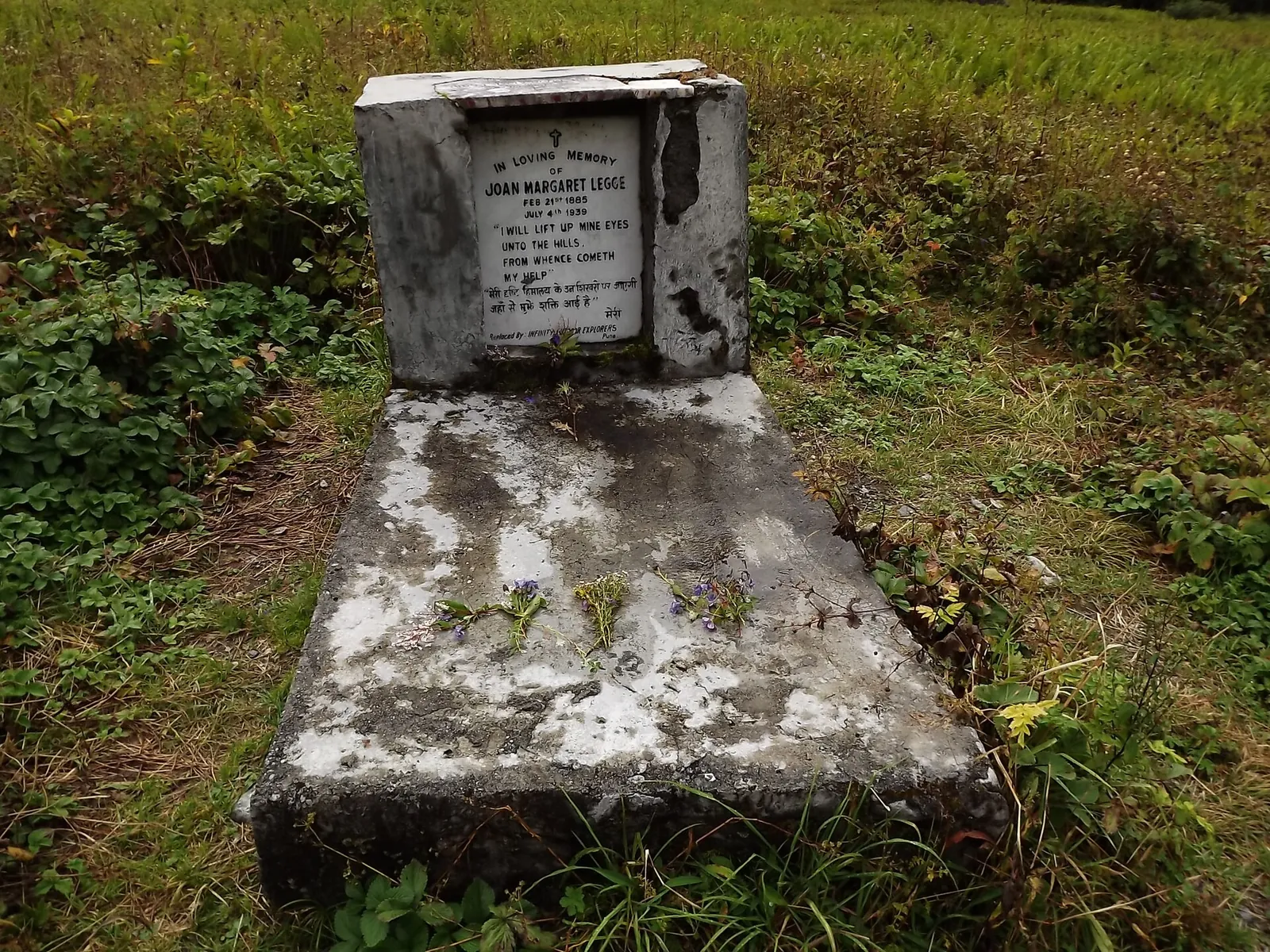
Two years later, Lady Joan Margaret Legge, a 54-year-old British botanist, came to the valley to collect plants. Most accounts say she was sent by the Royal Botanic Gardens, Kew. Some say the Royal Botanic Garden Edinburgh backed the trip. On 4 July 1939, while crossing steep rocky slopes to collect specimens, she slipped and fell to her death. She was buried in the valley.
Her sister later travelled out and built a memorial over the grave, which still stands beside the visitor trail. The stone is reported to carry a verse from Psalm 121: I will lift up mine eyes unto the hills, from whence cometh my help. In 2010, botanists described a new balsam found near the valley and named it Impatiens leggei in her honour.
Hemkund Sahib: a parallel history
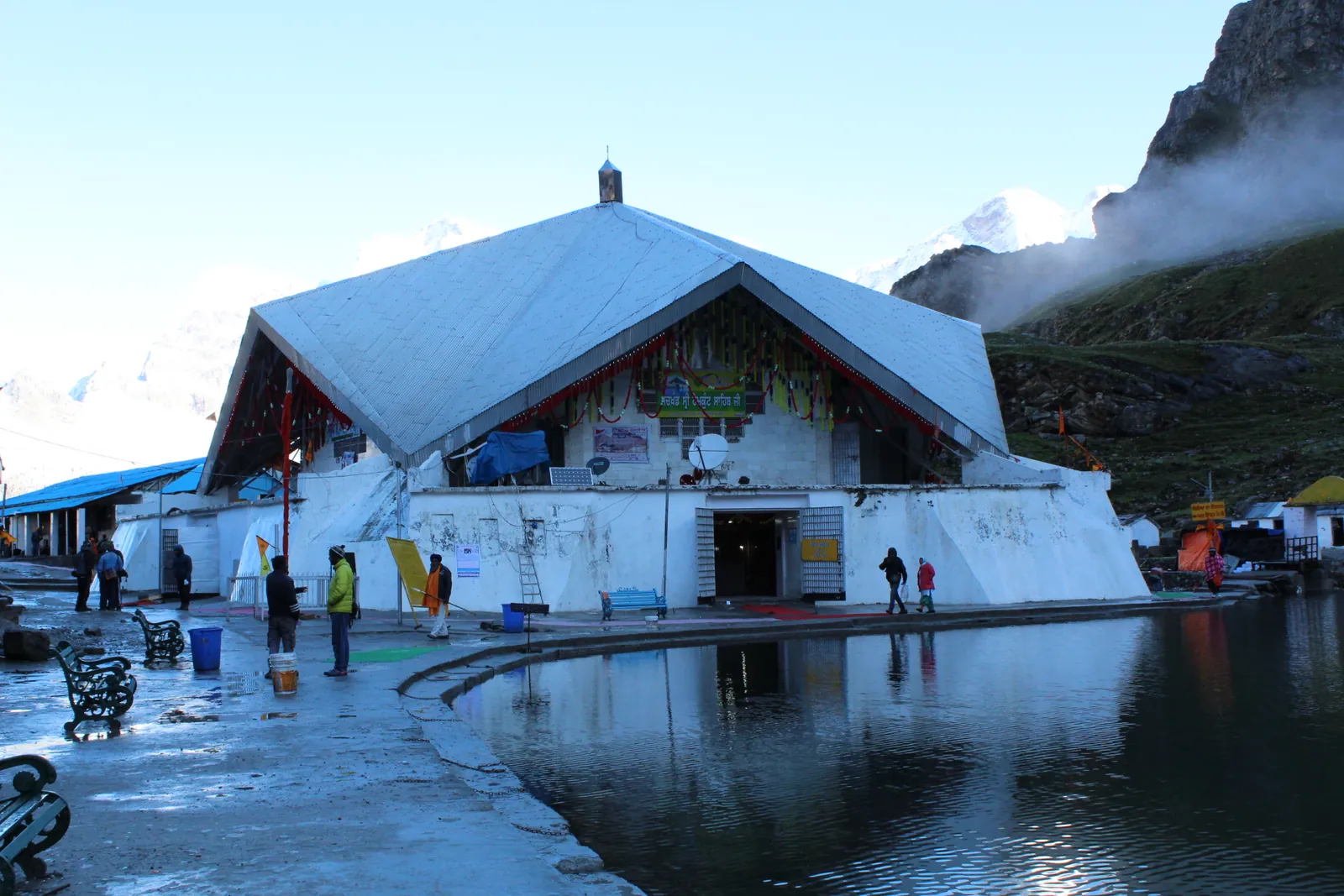
The lake above Ghangaria has a history of its own. Local people knew it as Lokpal and kept a small temple to Lakshmana on its shore. In the Dasam Granth, Guru Gobind Singh describes meditating in a former life beside a lake among seven snowy peaks. In the 1930s, Sikh pilgrims led by Sant Sohan Singh, with help from Havildar Modan Singh, identified Lokpal as that place, Hemkund. A small gurdwara was built there in the mid-1930s, with sources giving 1936 or 1937, and the present building was designed from the 1960s.
Hemkund lies outside the national park, but it changed the valley's story. Pilgrims turned Ghangaria into a busy seasonal village, and the 2005 IUCN evaluation counted up to 500,000 of them passing through each summer, far more than ever visit the valley itself.
From botanists to a national park
After Smythe and Legge, Indian botanists took over. The IUCN evaluation records surveys by the Botanical Survey of India in the 1950s and 1960s, and in 1987 the Survey published a botany of the park and its surroundings, which is still the standard checklist of its plants.
Their work, and concern about the effect of grazing on the flora, led the government of Uttar Pradesh, which then included this region, to declare the valley a national park on 6 September 1982, under the Wildlife (Protection) Act, 1972. It was the first national park in India created specifically to protect plants.
The grazing ban and the knotweed problem
Ending grazing had an unexpected result. With no sheep and goats to keep it down, Himalayan knotweed (Polygonum polystachyum) spread over the old livestock camps and formed what the IUCN called virtual monocultures. The IUCN asked for its stands to be mapped every year by GPS while cutting trials continued. A later study of the valley's changing vegetation named knotweed as the greatest danger to its flora, and noted that the blue poppy can hardly be seen now.
Ecologist Chandra Prakash Kala, who began surveying the valley in 1993, points out the other side: knotweed grows mostly on disturbed ground such as eroded and avalanche-prone slopes, and its deep roots help hold the soil. The meadows you see are not untouched wilderness. They are a landscape that changed when people stopped using it, and one that managers are still learning to look after.
UNESCO World Heritage status
Nanda Devi National Park, next door, became a World Heritage Site in 1988. India nominated the Valley of Flowers as an extension in 2004. Two IUCN evaluators visited, Kala was asked to review the nomination independently, and on 14 July 2005 the World Heritage Committee added the valley. The combined site is called Nanda Devi and Valley of Flowers National Parks.
UNESCO's reasons are worth reading. It praises the valley's gentle landscape, its meadows of alpine flowers and its ease of access, which complement the rugged, hard-to-reach Nanda Devi sanctuary. It also points to the flora: the valley sits where the Zanskar and Great Himalaya ranges meet and where eastern and western Himalayan plants overlap, several of its species are globally threatened, and it holds more threatened medicinal plants than other protected areas in the Indian Himalaya.
| Fact | Figure |
|---|---|
| Area | 87.5 square kilometres |
| Altitude range | About 3,200 m to 6,708 m |
| Cover | 73% permanent snow and ice, 21% alpine meadow, 6% forest |
| Plants listed | About 520 vascular plants, about 500 of them flowering (Kala) |
| National park since | 6 September 1982 |
| World Heritage Site since | 14 July 2005, as an extension of the 1988 Nanda Devi site |
Floods, roads and crowds: the recent history
In June 2013, the floods that devastated Kedarnath struck here too. A report carried from The Hindu says the park opened on 1 June that year and closed on 16 June, after landslides and the loss of the bridge over the Pushpawati that links Ghangaria to the park. Only 487 tourists visited that season, against about 7,000 expected, and press reports describe the park reopening fully to tourists in 2016.
Visitor numbers have since grown well past the old level. Press reports of Forest Department figures give 19,436 visitors in 2024, including 330 from abroad, and 15,924 in 2025, when bad weather cut the season. By 30 July 2026, Amar Ujala reported 16,462 visitors, already more than the whole of 2025.
| Season | Visitors |
|---|---|
| 2013 | 487 visited, against about 7,000 expected, after the June floods closed the park |
| 2024 | 19,436, including 330 from abroad |
| 2025 | 15,924, including 416 from abroad |
| 2026 | 16,462 by 30 July, including 86 from abroad |
What trekkers say
“I did the trek in 2009 (there was literally just me and couple of other solo trekkers on the trail back then) and I'm yet to see such a breathtaking landscape.”
Where the records disagree
Dates and details that vary between sources
We have followed the 2005 IUCN evaluation where sources conflict, because it was prepared for the World Heritage listing. The differences are listed below so you can judge for yourself.
- National park: 6 September 1982 in the IUCN evaluation and the Key Biodiversity Areas factsheet. Wikipedia's timeline cites a 1980 government order.
- End of grazing: 1982 according to the IUCN and Kala, 1983 according to UNESCO's summary.
- The name: most accounts date it to the 1931 crossing. The Himalayan Journal says Smythe named the valley on his 1937 visit. His book used the name in 1938.
- Joan Legge's sponsor: Kew in most sources, Edinburgh in some.
- The first gurdwara at Hemkund: 1936 in some sources, 1937 in others.
- Altitude: Wikipedia gives 3,352 to 3,658 m for the valley. The IUCN gives about 3,200 to 6,708 m for the whole park, peaks included.
Frequently asked questions
Who discovered the Valley of Flowers?
Local people always knew it. The first recorded crossing by outsiders was in 1907, and Frank Smythe, Eric Shipton and R. L. Holdsworth reached it in July 1931. Smythe's 1938 book gave it its English name, which is why he is usually credited.
Why is it called the Valley of Flowers?
Because of Frank Smythe's 1938 book of that name. Locally it is part of the Bhyundar valley, and in Hindi it is Phoolon ki Ghati.
When did the Valley of Flowers become a national park?
On 6 September 1982, according to the IUCN evaluation, although some sources cite a 1980 government order. It was India's first national park created specifically to protect plants.
When did it become a UNESCO World Heritage Site?
On 14 July 2005, as an extension of the Nanda Devi National Park site, which was inscribed in 1988.
Who was Joan Margaret Legge?
A British botanist who died in a fall in the valley on 4 July 1939 while collecting plants. Her sister built the memorial that still stands beside the trail.
Is the Valley of Flowers mentioned in the Ramayana?
Not by name. Local tradition links the area to Hanuman's search for the sanjeevani herb and to Lakshmana at Hemkund, but this is folklore rather than a recorded fact.
Why was grazing banned, and what changed?
Grazing ended when the national park was created in 1982, to protect the flora. Without grazing, Himalayan knotweed spread over the old livestock camps, which managers now monitor.
Was the valley damaged in the 2013 floods?
Yes. The bridge to Ghangaria was washed away and the park closed on 16 June 2013. Press reports describe it reopening fully to tourists in 2016.
Sources and how we wrote this
ValleyOfFlowers.in is an independent guide. This article is a research summary, not a first-hand trip report. We compared official and press sources, trek operators' pages and public Reddit threads, and where they disagree we say so. Prices and rules change each season, so confirm with the Uttarakhand Forest Department or the operator before you pay.
- UNESCO World Heritage Centre: Nanda Devi and Valley of Flowers National Parks
- IUCN (2005): World Heritage evaluation of the Valley of Flowers National Park
- Kala, C. P.: How Valley of Flowers got World Heritage Site tag (Down To Earth)
- Kapadia, H. (1989): In Famous Footsteps, Himalayan Journal 45
- Outlook Traveller (2014): Where the wild flowers are
- Speaking Tiger: The Valley of Flowers by Frank Smythe
- Wikipedia: Kamet
- Wikipedia: Lady Joan Legge
- Wikipedia: Gurdwara Hemkund Sahib
- Wikipedia: Valley of Flowers National Park
- Wadhwa, Rao and Hajra (1987): Botany of the Valley of Flowers National Park and its Environs, Bulletin of the Botanical Survey of India 29
- Vanishing plant wealth of the Valley of Flowers (Journal of Phytology)
- Key Biodiversity Areas: Valley of Flowers National Park factsheet
- Vagabond Images (2013), citing The Hindu: Valley of Flowers National Park to remain closed this year
- The Quint (2016): Valley of Flowers open to tourists three years after the Kedarnath deluge
- ETV Bharat (2024): Valley of Flowers closed for visitors ahead of winter
- Amar Ujala (2026): 16,462 tourists in two months (Hindi)
- Reddit thread linked above (r/SoloTravel_India)
Photo credits (3)
Photos are used under the open licences shown. Each credit links to its source.
- The valley in full summer green: Rohit Sharma · CC BY-SA 4.0 · source
- Memorial to botanist Joan Margaret Legge, who died here in 1939: Guptaele · CC BY-SA 4.0 · source
- Gurudwara Hemkund Sahib reflected in the lake on a clear morning: SD Bhalla · CC BY-SA 4.0 · source