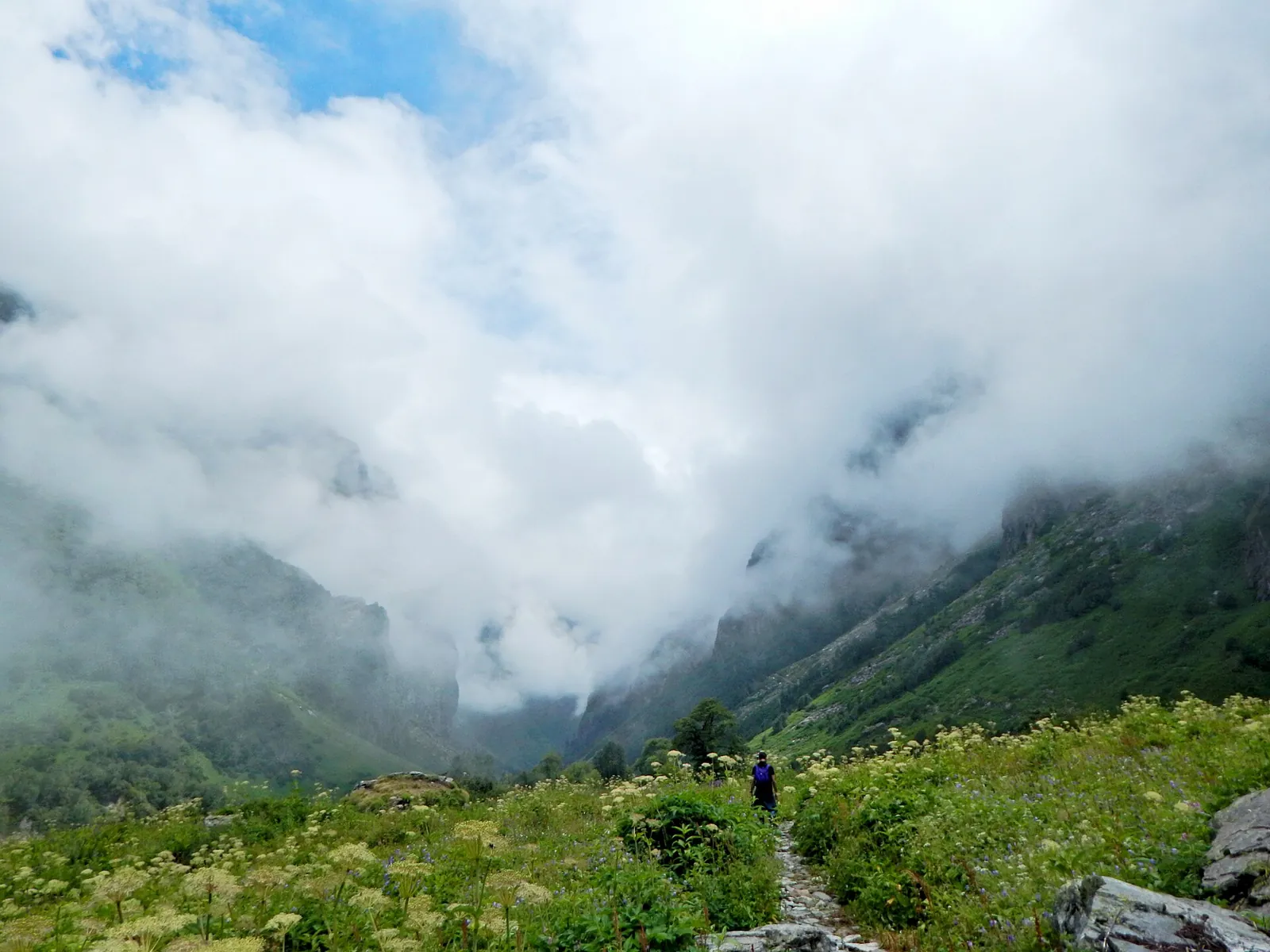
The weather on this trek changes with every step up. Govindghat, where the road ends, is warm and humid in the monsoon. Ghangaria, where you sleep, is cool. The meadows are cooler still, and the climb to Hemkund Sahib ends near freezing even in July. On top of that comes the monsoon: heavy rain from late June to early September, with cloud and showers building on many afternoons. This guide gives day and night temperatures for each stop and each stretch of the season, explains how a typical monsoon day unfolds, shows where the published numbers disagree, and turns all of it into what to wear.
Last checked 23 November 2026
Temperatures at a glance
The table shows typical highs and lows through the season at two places: Ghangaria, where everyone sleeps, and the meadows of the valley itself. The figures come from a weather reanalysis, a computer reconstruction of past weather, averaged over 11 seasons (2015 to 2025). The notes under the table explain what that can and cannot tell you.
| Period | Ghangaria day / night | Meadows day / night | Frosty nights at the meadows |
|---|---|---|---|
| 1 to 15 June | 14 / 5 °C | 11 / 3 °C | About 2 of 15 |
| 16 to 30 June | 16 / 9 °C | 13 / 6 °C | Almost none |
| July and August | 17 to 18 / 11 to 13 °C | 15 / 9 to 10 °C | None |
| 1 to 15 September | 16 / 10 °C | 13 / 7 °C | Almost none |
| 16 to 30 September | 15 / 7 °C | 12 / 5 °C | About 1 of 15 |
| 1 to 15 October | 12 / 4 °C | 10 / 1 °C | About 5 of 15 |
| 16 to 31 October | 9 / 0 °C | 7 / minus 3 °C | About 13 of 16 |
Method: daily highs and lows from the ERA5-Land reanalysis (a 9 km grid), taken from Open-Meteo's historical archive for 2015 to 2025. Values are corrected to Ghangaria's 3,100 m and the meadows' 3,500 m using the standard 6.5 °C per 1,000 m. A frosty night is a daily low below 0 °C.
This is a model of a 9 km square, not a thermometer in the valley. When we moved to the next grid square, July and August highs shifted by 1 to 2 °C. It also runs warmer at night than trek operators report (see below). We did not use its rainfall, because a 9 km square cannot separate Govindghat, where trek leaders report heavier rain, from the valley higher up.
How much colder it gets as you climb
Air cools by about 6.5 °C for every 1,000 m you go up. On this route that adds up fast. Govindghat to Hemkund Sahib is about 2,400 m of climbing, so Hemkund runs some 15 °C colder than the road head. The table covers July and August, the warmest part of the season.
| Place | Altitude | Typical day | Typical night | Coldest night in 11 seasons |
|---|---|---|---|---|
| Govindghat | About 1,800 m | About 26 °C | About 20 °C | About 13 °C |
| Ghangaria | About 3,100 m | 17 to 18 °C | About 12 °C | About 5 °C |
| Valley meadows | About 3,500 m | About 15 °C | About 9 °C | About 2 °C |
| Hemkund Sahib | About 4,200 m | About 10 °C | About 5 °C | About minus 2 °C |
In the model, Hemkund dips below freezing on about one night in each of July and August. Altitudes follow our altitude guide. Hemkund's published height varies by hundreds of metres, so its temperatures are the least certain of the four.
The rhythm of a monsoon day
Wikipedia's climate section for the park describes the area as an inner Himalayan region, shielded from the full force of the southwest monsoon by the Greater Himalaya to its south, with heavy rain from late June to early September and mist and low cloud that keep the soil moist. That damp suits the flowers. Trek leaders quoted in our best-time guide add that rain at Govindghat is often heavier than higher up, where it is frequently a drizzle.
On the trail itself, one operator's trip pages describe a steady daily pattern.
One operator's pattern, not a promise
This timetable comes from a single operator's pages, and the monsoon keeps no schedule. It does fit the park's hours, though: entry is allowed from 7 am to 2 pm, and visitors must be out by 5 pm. The practical rule is the same either way. Enter at 7 am, spend the clear morning in the valley, and carry rain gear from the first step.
- Before sunrise: cold and clear. In June the same operator reports below 5 °C before sunrise, and it advises a warm hat and light gloves for 6 am departures from Ghangaria.
- Morning: usually clear, and the best time for views. On the Hemkund day, it says, "the morning air is clearer before clouds build."
- From about noon in July: rain builds. In August the operator reports "daily afternoon rain" and diffused light all day, and its guides head back before the 2 pm rain builds.
- Evening: cold at Ghangaria. The operator says to expect 4 to 6 °C by 8 pm even in July.
Cloud, fog and views
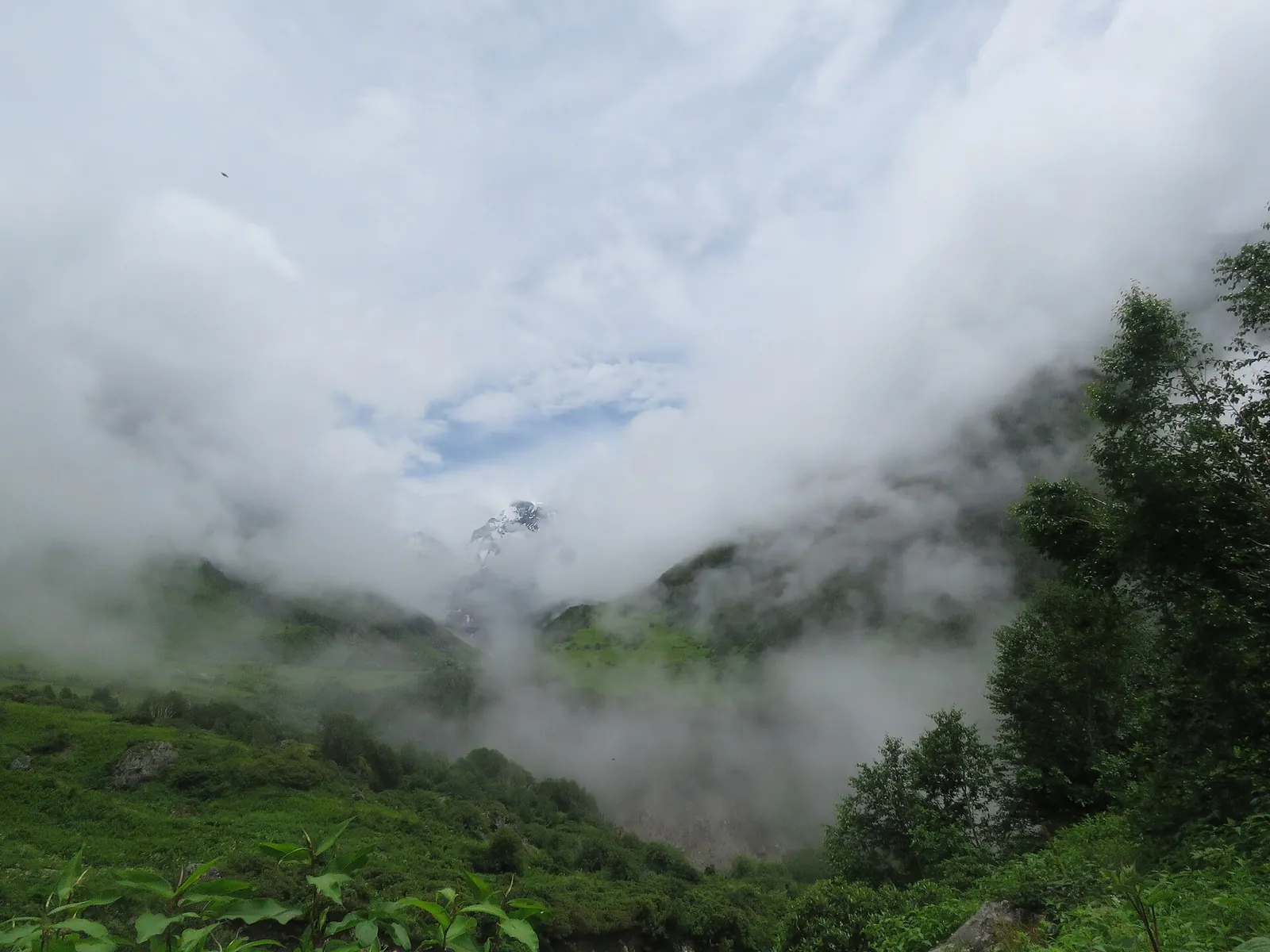
Cloud is as much a part of the weather as rain. Wikipedia notes "dense fog and rain" especially in the late monsoon. In August the operator above describes diffused light all day, and in September it says skies clear to give "views that August cloud cover often blocks."
In practice, if the snow peaks above the valley matter to you, the clear mornings of late July and the weeks of September give you the best chance. If you want soft light for close-up flower photos, August delivers it, and the skyline is the price.
Month by month
June: cold clear mornings and snow patches
The park opens on 1 June. Mornings are cold and clear and the rain has not set in. One operator reports below 5 °C before sunrise and afternoons up to 17 °C, with snow still on the upper slopes for the first two weeks. The model agrees on the cold: highs at the meadows average about 11 °C in the first half of June, with about 2 frosty nights. By the second half, highs reach about 13 °C at the meadows and 16 °C at Ghangaria, and frost is rare. Snow bridges and patches along the stream remain.
July: green, cool and wet from midday
Highs of 17 to 18 °C at Ghangaria and about 15 °C at the meadows, with nights of about 12 and 9 °C in the model. The operator reports daily rain, typically from noon onwards, with clear mornings, and a range of 6 to 15 °C. July and August are almost identical in temperature, so rain and cloud matter more than the date.
August: the wettest and cloudiest month
Temperatures match July in the model. The operator reports a "consistent heavy monsoon", daily afternoon rain, diffused light all day, and a range of 6 to 12 °C. Expect to be wet at some point whatever your start time.
September: clearer skies, colder nights
Rain eases and the cloud lifts. In the model, Ghangaria nights fall from about 10 °C in the first half of the month to about 7 °C in the second, and the meadows touch frost about once in the last 15 days. Hemkund is colder still: at 4,200 m the model shows about 10 nights below freezing across September.
October: frost, then snow
The park is open until 31 October, but the weather is turning. In the model, Ghangaria sees frost on about 3 of the first 15 nights of October and about 9 of the last 16. The meadows see about 5 and 13. Highs in the final fortnight fall to about 9 °C at Ghangaria and 7 °C at the meadows. The operator says snow reappears on the ridges, and Wikipedia says the valley is usually snow-bound for six to seven months, from late October to late March. We found little first-hand reporting from October, so this is the month where the numbers deserve the least trust.
Where the temperature figures disagree
Plan for the cold end
The sources describe different places and times of day. A daytime high is usually a midday reading on a trail below the cloud. A night low is the coldest reading before dawn, and cold air tends to collect on valley floors on clear nights, which a 9 km model cannot see. The model puts Ghangaria at or below 6 °C on only about 5 nights in 11 Julys and Augusts, yet an operator reports 4 to 6 °C by 8 pm. We cannot say which is closer for the night you will be there. Plan for the colder reports: warm layers at Ghangaria, and single digits on the early walk into the valley.
| Source | What it reports |
|---|---|
| Our model data, Ghangaria, July and August | About 17 to 18 °C by day, 12 °C at night |
| Our model data, valley meadows | About 15 °C by day, 9 °C at night |
| Indiahikes trek leaders, on the trail, July to September | About 10 to 18 °C by day, 3 to 5 °C at night |
| Other guides, Ghangaria | Nights of 5 to 10 °C |
| Cliffhangers India, July | 6 to 15 °C, with 4 to 6 °C at Ghangaria by 8 pm |
| Cliffhangers India, August | 6 to 12 °C |
What to wear and carry for this weather
What trekkers say
“They will charge you a fortune in ghangria to dry them over charcoal. Try to avoid getting your shoes wet if it doesn't rain.”
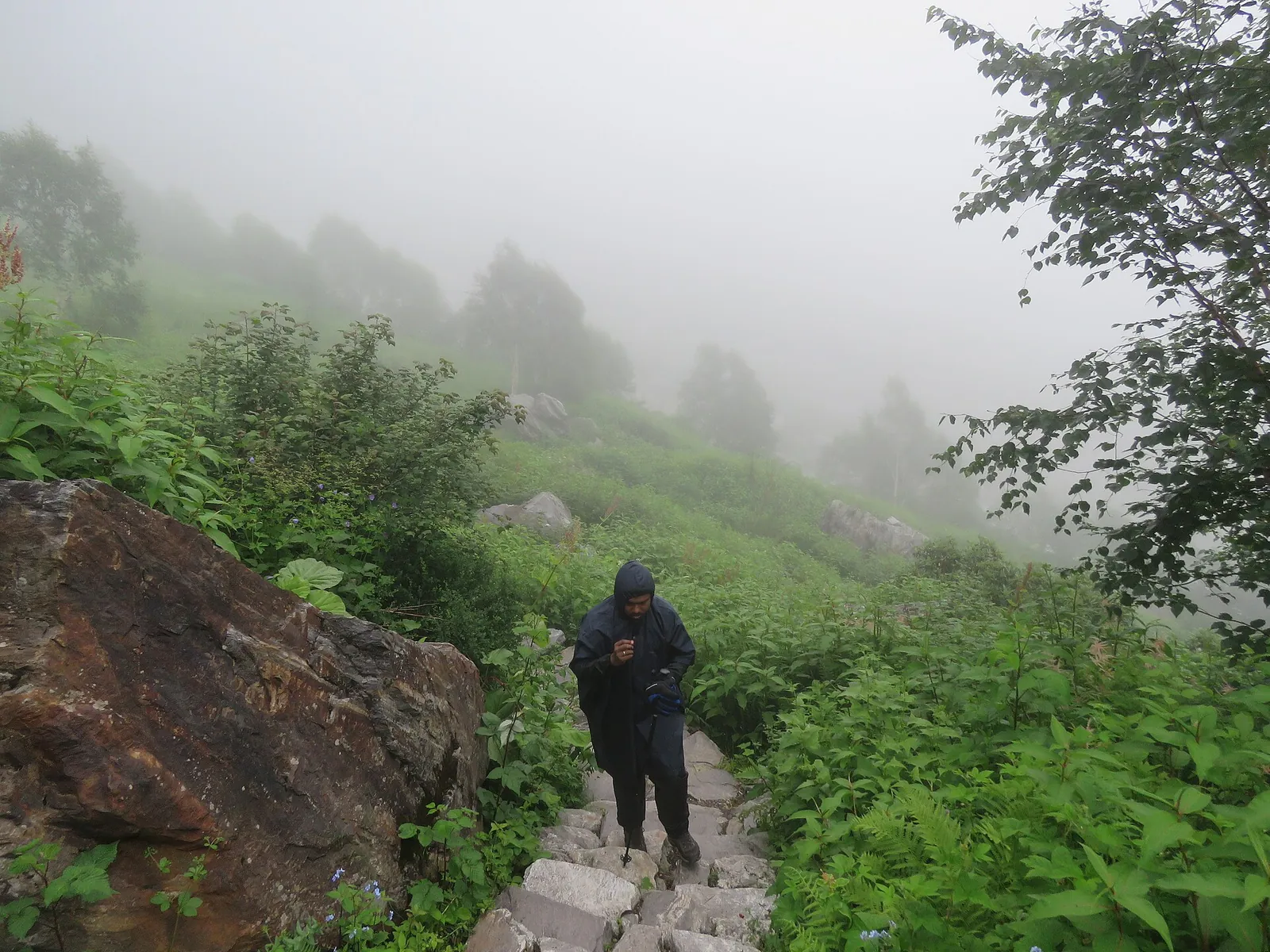
- A waterproof outer layer. Many trekkers on Reddit choose a poncho, and one operator lists a poncho or pack cover to keep the daypack dry. The same operator says a softshell or water-resistant layer will not hold up in sustained monsoon rain and asks for a proper waterproof hardshell. Either can work. Trekkers on Reddit advise against umbrellas (see our best-time guide).
- Waterproof shoes with good grip. The same operator calls waterproof trekking shoes "not optional" and says the valley floor "is permanently wet."
- Layers rather than one thick coat: a thermal base, a fleece or insulated mid-layer (the operator calls it especially important on the Hemkund day), and the waterproof on top.
- A warm hat and light gloves for the 6 am start from Ghangaria, and thermals for sleeping.
- No cotton. It holds water and stops insulating once damp.
- Sun protection for the clear mornings: a cap, sunglasses and sunscreen. The sun is strong at this height.
- A dry bag or sealed pouch for your permit, cash and phone.
This is a weather-driven checklist drawn from the sources below, not a complete packing list.
When the weather changes your plans
- The road comes first. Landslides on the highway to Govindghat cost more days than weather on the trail. Our best-time guide explains how many spare days to keep.
- Check before you climb. Look at the India Meteorological Department's forecast and any district warning for Chamoli, and ask your hotel in Joshimath or Govindghat about the road that morning.
- The helicopter is not rain-proof. One Ghangaria guide notes that heavy rain in the peak season can affect the service.
- In the valley, leave by the 5 pm exit time, and earlier if cloud and rain build.
- Late in the season, snow ends everything. The park closes on 31 October, and the same Ghangaria guide says the village is completely covered by snow from December to February.
Frequently asked questions
What is the temperature in the Valley of Flowers in July?
In our weather-model data, about 17 to 18 °C by day and 12 °C at night at Ghangaria, and about 15 °C by day and 9 °C at night in the meadows. Indiahikes reports about 10 to 18 °C by day and 3 to 5 °C at night on the trail. Pack for the lower end.
Is it cold at Ghangaria at night?
Colder than many visitors expect for July. One operator reports 4 to 6 °C by 8 pm even in July, and other guides put nights at 5 to 10 °C. Our model data is warmer, at about 12 °C. Take thermals and a fleece.
Does it rain every day in the Valley of Flowers?
In July and August, very often. One operator reports daily rain from about noon in July and daily afternoon rain in August. Trek leaders say rain at Govindghat is often heavier than higher up. June and September are lighter. Carry rain gear every day.
What time of day does it rain?
One operator reports clear mornings with rain building from about noon in July and August, and it heads back before the 2 pm rain. Treat that as a pattern, not a rule.
Does it snow in the Valley of Flowers?
Not in the main season, but old snow lingers. Snow bridges and patches remain along the stream in June, and one operator reports snow on the upper slopes for the first two weeks. Snow returns to the ridges in October, and the valley is usually snow-bound for six to seven months from late October to late March.
Which month has the best weather?
June and September are the drier months, and September has the clearest views. The most flowers come in the last week of July to about 15 August, with rain. July and August are almost the same in temperature.
How cold is Hemkund Sahib?
About 10 °C by day and 5 °C at night in July and August in our model data, with a night below freezing about once a month. Snow can fall there early in the season, in late May and June.
What should I wear on the Valley of Flowers trek?
A waterproof jacket or poncho, waterproof shoes, a fleece, thermals for nights at Ghangaria, a warm hat and gloves for early starts, and no cotton. Add sun protection for the clear mornings.
Sources and how we wrote this
ValleyOfFlowers.in is an independent guide. This article is a research summary, not a first-hand trip report. We compared official and press sources, trek operators' pages and public Reddit threads, and where they disagree we say so. Prices and rules change each season, so confirm with the Uttarakhand Forest Department or the operator before you pay.
- Open-Meteo: Historical Weather API, ERA5-Land reanalysis (weather data by Open-Meteo.com), used for the model temperatures
- Copernicus Climate Change Service: ERA5-Land reanalysis (contains modified Copernicus Climate Change Service information)
- Cliffhangers India: Valley of Flowers trek 2026 (monthly weather, rain timing and packing)
- Indiahikes: Best time to visit Valley of Flowers (temperatures)
- Wikipedia: Valley of Flowers National Park (climate)
- Renok Adventures: About Ghangaria (weather by season, helicopter service)
- India Meteorological Department: forecasts and warnings, for checking before you travel
- Reddit thread linked above (r/SoloTravel_India)
Photo credits (4)
Photos are used under the open licences shown. Each credit links to its source.
- Monsoon cloud filling the valley: John Muir Fan 86 · CC BY-SA 4.0 · source
- Cloud lifting off the peaks after rain: Vinayaraj · CC BY-SA 4.0 · source
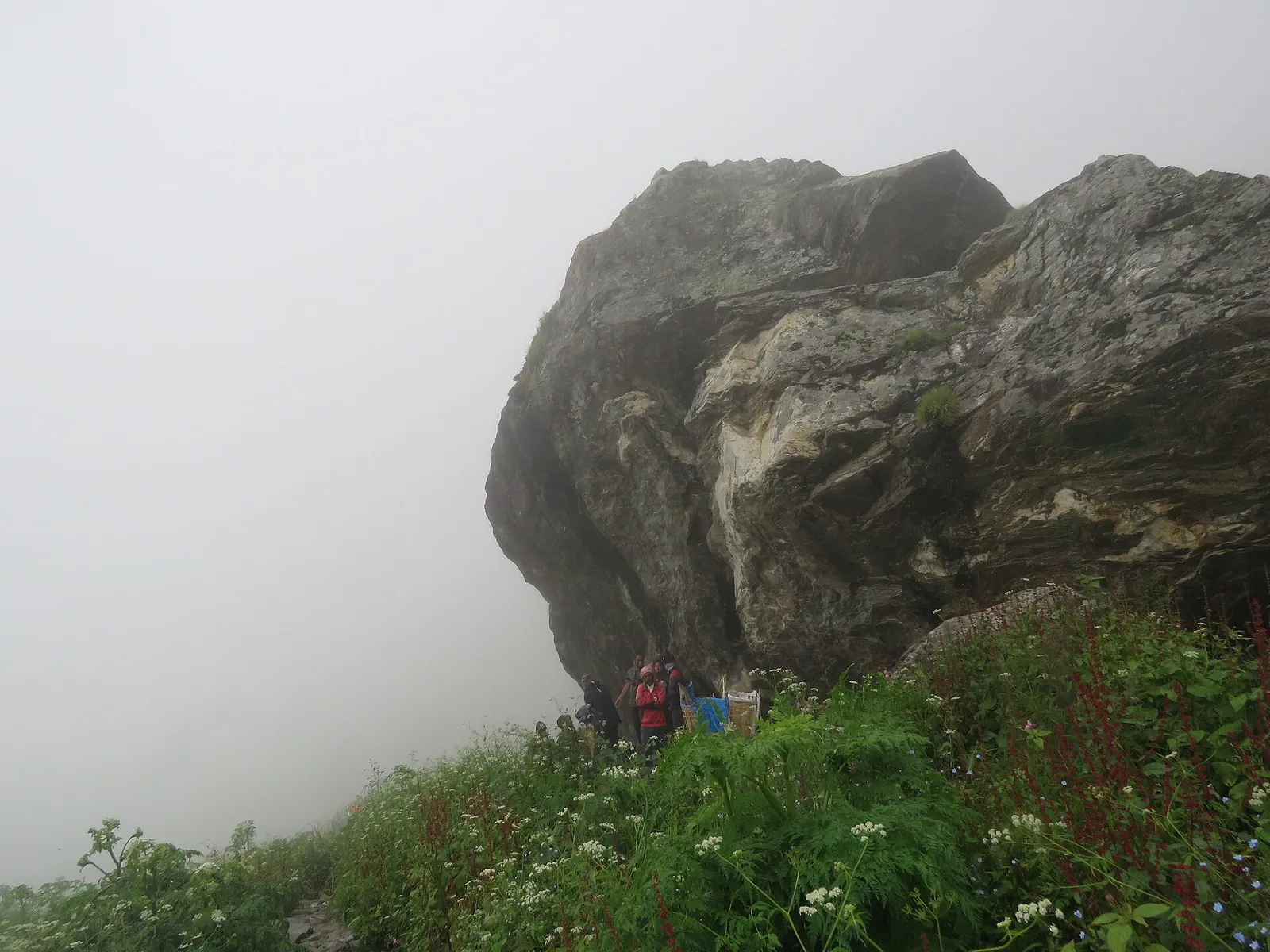
- Trekkers passing a giant boulder in the mist: Vinayaraj · CC BY-SA 4.0 · source
- A trekker in rain gear on the stone path: Vinayaraj · CC BY-SA 4.0 · source