More photos: Brahma Kamal on the slopes below Hemkund · Brahma Kamal in the gallery.
Brahma Kamal
Saussurea obvallata
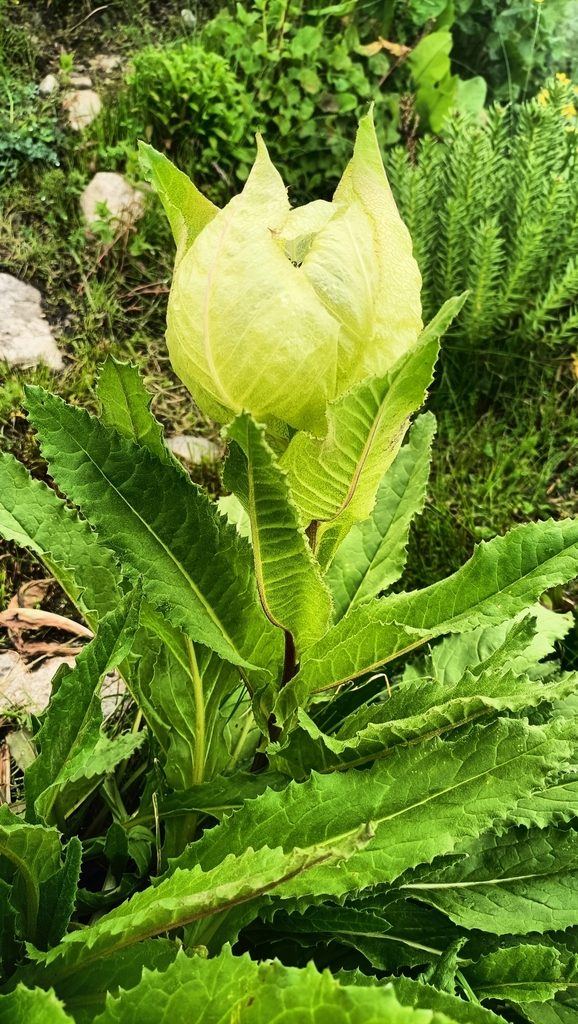
Recorded in the valleyState flower of Uttarakhand. Papery cream bracts wrap a dark purple flower head like a lantern; sacred and offered at Himalayan shrines.
Also known as: State flower of Uttarakhand · Also spelled Brahmakamal; 'Brahm Kamal' in older surveys
- Botanical name
- Saussurea obvallata
- Family
- Asteraceae
- Colour
- Cream bracts, purple head
- Bloom season
- July – September
- Altitude
- 3,000 – 4,800 m
- Status
- Threatened by harvesting
Last checked 18 October 2026
Picking or uprooting any plant inside the national park is prohibited. Photograph, don’t pluck.
About Brahma Kamal
Brahma Kamal does not look like a typical flower. Each plant is a pale, lantern-like cone of papery bracts, wrapped around a small dark purple flower head, held above a rosette of long, toothed leaves. The bracts act as a kind of greenhouse, shielding the flowers from the cold of high altitude.
The plant is sacred in Uttarakhand. It is the state flower, and it is offered at hill temples such as Badrinath and gathered for the Nanda Devi festivals. That reverence is also a threat: the same plant is taken for ritual and for medicine.
How to recognise it
A single, upright, pale green-cream 'bud' of overlapping bracts standing in a rosette of sharply toothed, lance-shaped leaves. The purple flower head sits hidden inside.
Where and when it grows
It grows on rocky and grassy slopes in the alpine zone, roughly 3,000–4,800 m, flowering in mid-monsoon (July to September). The botanical survey describes many Brahma Kamal on the upper slopes around Hemkund Lake, and trekkers commonly report seeing it along the Hemkund Sahib route.
Where to see it on the trek
Brahma Kamal grows higher than most of the valley's flowers. The Botanical Survey of India describes many plants on the upper slopes around Hemkund lake, and that is where trekkers usually see it: on the climb to Hemkund Sahib and around the lake, rather than along the main valley trail.
Look from July to September for pale, lantern-like heads standing among grass and rocks. Once you know the shape they are easy to spot, because nothing else on those slopes looks like a cream-coloured bud the size of a fist.
The Hemkund climb gains about 1,100 m from Ghangaria, so pace yourself and read our altitude guide first. Photograph it from the path. Picking or uprooting it in the national park is illegal, and plants taken for offerings and medicine are the main pressure on it.
See the climb on the interactive trek map (choose Hemkund Sahib), and read Valley of Flowers altitude and altitude sickness before you go.
What trekkers say
“Yes, hemkund sahib was quite beautiful than VoF. It had energy,it had blue poppy flower, brahmakamal and what not.”
People and plants
The thick curved root is applied to bruises and cuts in local medicine, and the plant features in Ayurvedic and Tibetan practice, although scientific testing of its effects is limited. It is gathered, usually on Nandashtami, for offering to the goddess Nanda Devi.
Conservation
Sources disagree on how threatened it is, with some calling it endangered or critically endangered; we could not confirm an IUCN category. Over-harvest for ritual and medicine, and loss of habitat, are the pressures named. Uttarakhand runs a germplasm conservation programme that includes it.
Good to know
- A popular legend says it blooms only at night, releasing a sleep-inducing fragrance, and wilts at dawn. Botanical sources describe an ordinary daytime bloom in mid-monsoon, so treat the night-blooming story as folklore.
- Despite a widespread claim, we found no source tying the flower to a specific ritual at Hemkund Sahib; it is a nearby landmark, not a documented part of the shrine's worship.
A note of caution. Do not pick or uproot it. Removal from the national park is illegal, and the plants are slow to recover.
How we know it grows here
Listed in the park's botanical checklist, which describes many plants on the upper slopes. iNaturalist has 10 research-grade observations from the valley and Hemkund Sahib area (36 counting the Govindghat–Ghangaria trail).
Listed in the park's botanical checklist or photographed inside the valley.
Frequently asked questions
Where can I see Brahma Kamal near the Valley of Flowers?
On the upper slopes around Hemkund lake and along the Hemkund Sahib path, from July to September. It is less common on the valley floor.
Is Brahma Kamal the state flower of Uttarakhand?
Yes. It is the state flower, and it is sacred in the hills, offered at temples such as Badrinath and to the goddess Nanda Devi.
Does Brahma Kamal bloom only at night?
Not the Himalayan plant. Botanical sources describe an ordinary daytime bloom in the monsoon. The night-blooming 'Brahma Kamal' sold as a garden plant across India is usually a different plant altogether, the cactus Epiphyllum oxypetalum, which really does flower at night.
What does Brahma Kamal look like?
A single upright cone of pale, papery bracts wrapped around a dark purple flower head, standing in a rosette of long, sharply toothed leaves.
Can I pick Brahma Kamal?
No. Removing any plant from the national park is illegal, and the species is under pressure from harvesting for ritual and medicine.
Sources and how we wrote this
ValleyOfFlowers.in is an independent guide. This page summarises the park's botanical survey, published research and research-grade observation records, together with trekkers' public reports. Where sources disagree, we say so.
- Wadhwa, Rao & Hajra (1987), Botany of the Valley of Flowers National Park and its Environs, Bulletin of the Botanical Survey of India 29
- Brahma Kamal: an important Himalayan medicinal plant (Semwal et al. 2020, Ethnobotany Research & Applications)
- Saussurea obvallata – Wikipedia
- Brahma Kamal: a flower of legends and lore (Daily Excelsior)
- eFlora of India: Epiphyllum oxypetalum, the night-blooming cactus also called Brahma Kamal
All photo credits
- (c) phiroza, some rights reserved (CC BY) · via iNaturalist · MJM2+82, Hemkund, Uttarakhand 246443, India
- (c) Dinesh Valke, some rights reserved (CC BY-SA) · via iNaturalist · , Uttarakhand, India
- (c) Dinesh Valke, some rights reserved (CC BY-SA) · via iNaturalist · , Uttarakhand, India