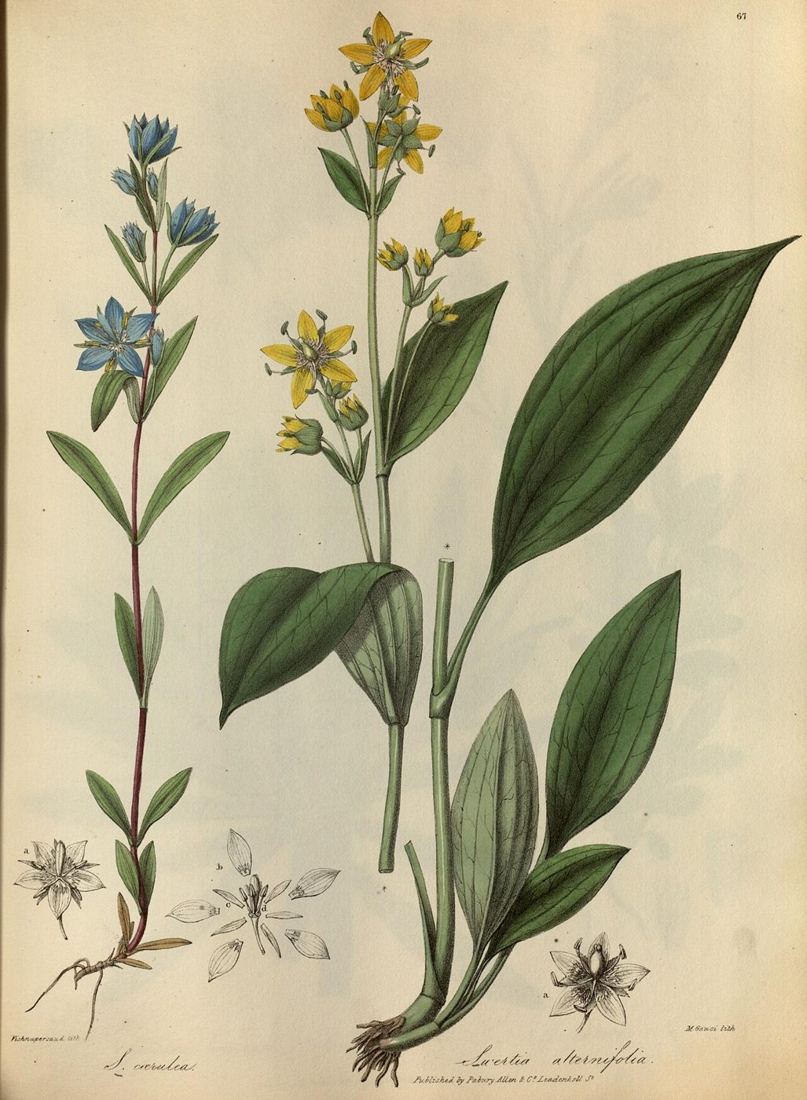
Chirata
Swertia chirayita
Wider Himalaya · not recorded in the valleyA bitter medicinal herb with star-shaped flowers; the valley's own Swertia species are different.
Also known as: Chirata, Chiraito, Chirayata · Sanskrit: Kirata, Kiratatikta · Swertia chirayita
- Botanical name
- Swertia chirayita
- Family
- Gentianaceae
- Colour
- Greenish-white
- Bloom season
- August – October
- Altitude
- 1,200 – 3,600 m
- Status
- Threatened by harvesting
Last checked 23 October 2026
Picking or uprooting any plant inside the national park is prohibited. Photograph, don’t pluck.
About Chirata
Chirata is one of the most bitter herbs of Ayurveda. Its Sanskrit name, Kiratatikta, is usually read as 'the bitter plant of the Kirata'. It is a tall, branching gentian, 0.6 to 1.5 m high, with orange-brown or purplish stems and many small, star-shaped, green-yellow flowers tinged with purple, grown and traded for its bitter, stomach-tonic stems.
The bitterness comes from compounds such as amarogentin, which a 2016 review calls the most bitter compound isolated so far. The same review lists uses against liver disorders, fever, malaria, indigestion and diabetes; we have not checked those claims.
One caveat: the botanical survey lists several other Swertia species for the valley, but not Swertia chirayita. We show it for completeness, because it is the Swertia people most often ask about.
How to recognise it
A tall, branched plant with narrow leaves and many small, star-shaped flowers. The stems are the giveaway: orange-brown or purplish, round below and four-sided above, with a large yellowish pith. The Swertia you are more likely to see on the trail are smaller. For example, Swertia ciliata has pale blue or bluish-white flowers with a purple band near the base.
Where and when it grows
Sources give widely different ranges. A 2016 review puts the plant at about 1,200 to 2,100 m in the sub-temperate Himalaya, on moist, shady slopes; other sources go up to about 3,600 m, and in Uttarakhand it is reported from places such as Tapovan, Dodital and Badrinath at around 3,500 to 3,900 m.
Where to see it on the trek
Do not expect to find this species on the trek. We found no record of it in the valley, and the park's survey names other Swertia instead. If someone points out chirata on the trail, treat that with caution.
What you can look for are the other Swertia, which are gentians with star-shaped flowers. If you are unsure which one you have found, photograph the whole flower and the leaf arrangement.
Never pick Swertia for the herb trade. The harvest is destructive and the plant is badly overcollected.
See the route on the interactive trek map, and read Valley of Flowers altitude and altitude sickness before you go.
People and plants
Used in Ayurveda as a bitter tonic, a stomachic and a fever remedy, and studied for liver protection. A 2016 review notes the whole plant is widely used, and that harvesting the underground parts is destructive.
Conservation
Called critically endangered in one assessment and Vulnerable in another. Over-harvesting, adulteration of supplies with other Swertia species, habitat loss and poor seed viability and germination are the problems named. The review notes a lack of data on how much is harvested and traded each year, and points to cultivation and micropropagation as ways to ease the pressure on wild plants.
Good to know
- Because demand outruns supply, other Swertia species are sometimes sold in its place, which is one reason people care about telling them apart.
A note of caution. Do not buy or collect wild chirata. If you want the herb, look for cultivated supplies.
How we know it grows here
Not listed in the park's botanical checklist, which names other Swertia species instead. Shown for completeness; the Swertia flowers you are most likely to see in the valley are the other, smaller species.
A Himalayan species often listed for the valley, but we could not find a record from it. Shown for completeness.
Frequently asked questions
Does Swertia chirayita grow in the Valley of Flowers?
We found no record of it there. The park's botanical survey lists other Swertia species for the valley, but not chirata.
Why is chirata so bitter?
It contains compounds such as amarogentin, which a 2016 review calls the most bitter compound isolated so far.
Is chirata endangered?
It is called critically endangered in one assessment and Vulnerable in another. Over-harvesting and adulteration are the main problems.
Which Swertia will I see in the valley?
Smaller Swertia such as S. ciliata, with pale blue or bluish-white flowers marked with purple, are likelier than chirata.
Can I collect it?
No. Picking plants in the national park is prohibited, and wild chirata is overharvested.
Sources and how we wrote this
ValleyOfFlowers.in is an independent guide. This page summarises the park's botanical survey, published research and research-grade observation records, together with trekkers' public reports. Where sources disagree, we say so.
- A review of Swertia chirayita as a traditional medicinal plant (Kumar & Van Staden 2016, Frontiers in Pharmacology)
- Wadhwa, Rao & Hajra (1987), Botany of the Valley of Flowers National Park and its Environs, Bulletin of the Botanical Survey of India 29
- Swertia chirayita – ICIMOD Landscape Database
- Swertia chirayita: a Himalayan herb
- Swertia ciliata – World Flora Online
All photo credits
- Historical illustration. Royle, J. Forbes · Public domain · via Wikimedia Commons