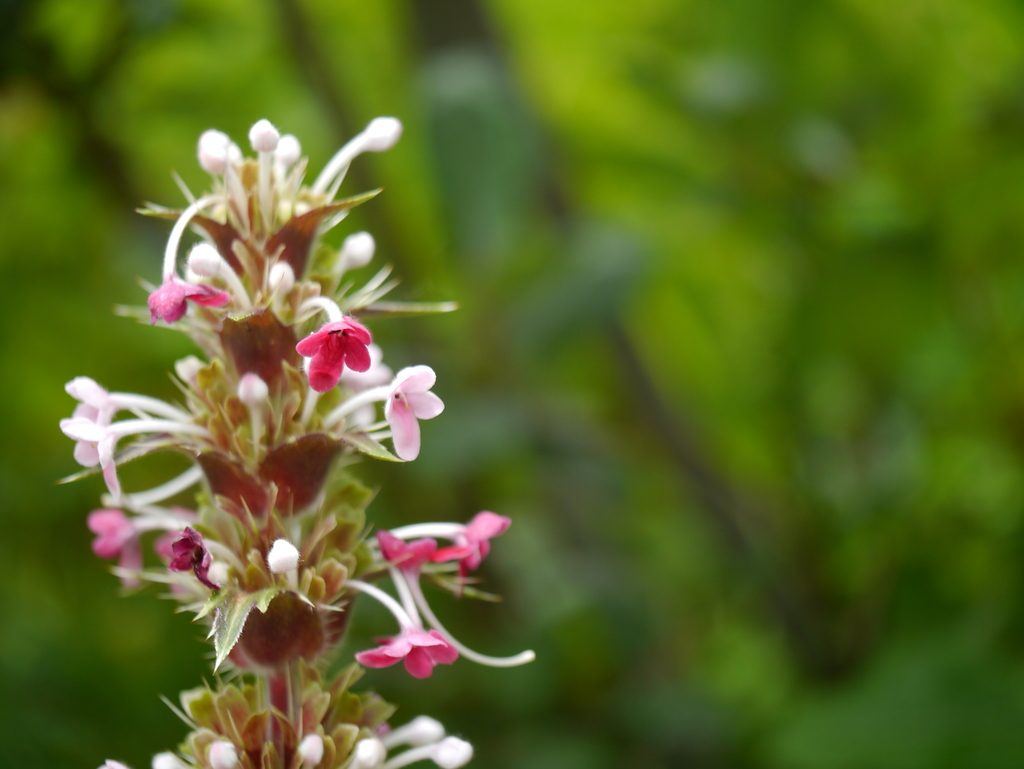
Himalayan Whorlflower
Morina longifolia
Recorded in the valleyWhorls of tubular flowers that change from white to deep pink after pollination.
Also known as: Himalayan whorlflower · Morina longifolia · Kashmiri: Kandij · Nepali: Kaandamasee, Thakaaili Kaandaa
- Botanical name
- Morina longifolia
- Family
- Caprifoliaceae
- Colour
- White turning crimson
- Bloom season
- July – September
- Altitude
- 3,000 – 4,000 m
Last checked 23 October 2026
Picking or uprooting any plant inside the national park is prohibited. Photograph, don’t pluck.
About Himalayan Whorlflower
Whorls of long, tubular flowers are stacked in rings up a stem, each ring backed by a collar of spiny bracts. The flowers open white, then turn pale pink and finally rosy red, so a single spike can carry three colours at once.
The colour change follows pollination and is thought to tell insects that a flower has already been visited, so they spend their time on the fresh ones. The tube is so long that moths are the likeliest pollinators, and gardeners report that the plants are also self-fertile.
The plant is a Himalayan perennial found from Kashmir to Bhutan. It grows up to about a metre tall from a rosette of glossy, dark green leaves with sharp spines along the margins, which is why people often take it for a thistle.
How to recognise it
A rosette of narrow, glossy, spiny-edged leaves and a stiff spike of tiered whorls of tubular flowers in white, pink and crimson. Check different tiers of the same spike: if the colours differ with height, it is this plant.
Where and when it grows
Open slopes and alpine shrubberies at about 3,000 to 4,000 m. Flowers of India gives June to September; the park's botanical survey records white-pink flowers from July to September. It is one of the most frequently recorded flowers in the valley and is sometimes described as growing in abundance there.
Where to see it on the trek
The valley meadows lie at roughly 3,200 to 3,600 m, well inside the plant's range, so this is one of the likelier flowers to find on an ordinary day walk. Look on open slopes and among alpine shrubs rather than in boggy ground.
Its spikes can reach about a metre and stand above the surrounding herbs, so scan for the tiers. Look at one spike from the side so that its white, pink and red whorls fall in one frame.
Stay on the path while you do. Trampled, compacted ground is where weedy invaders take hold (see our page on Himalayan knotweed), and the meadow here is fragile.
See the route on the interactive trek map, and read Valley of Flowers altitude and altitude sickness before you go.
People and plants
Mainly ornamental; it is a popular, drought-tolerant garden plant. The plant is used as an incense, and the roots yield about 0.34% essential oil. The Plants For A Future database also reports that the stem, leaves and flowers are used in Tibetan medicine as a digestive; we did not find clinical evidence for that.
Good to know
- Botanists place Morina in the honeysuckle family (Caprifoliaceae), not the thistle family it resembles.
- Fine Gardening recommends it as a drought-tolerant summer plant, a sign of how well it copes with thin, stony mountain soil.
A note of caution. It has no known hazard, but the leaf spines are sharp enough to scratch. Do not pick it: removing flowers from the park is prohibited.
How we know it grows here
Listed in the park's botanical checklist (white-pink, July to September). iNaturalist has 25 research-grade observations from the valley and Hemkund Sahib area (27 counting the Govindghat–Ghangaria trail).
Listed in the park's botanical checklist or photographed inside the valley.
Frequently asked questions
Why does the Himalayan whorlflower change colour?
The flowers open white and turn pink, then rosy red, after they are pollinated. The change is thought to tell insects which flowers have already been visited.
Is Morina a thistle?
No. It looks like one, with spiny leaves and bracts, but it belongs to the honeysuckle family, Caprifoliaceae.
When does it bloom in the Valley of Flowers?
The park's botanical survey records July to September; other sources say June to September.
Where do I look for it?
On open slopes and alpine shrubberies between about 3,000 and 4,000 m, which takes in the valley meadows.
Is it used for anything?
It is grown as a garden plant, burned as an incense, and used in Tibetan medicine as a digestive. We found no clinical evidence for the medical use.
Sources and how we wrote this
ValleyOfFlowers.in is an independent guide. This page summarises the park's botanical survey, published research and research-grade observation records, together with trekkers' public reports. Where sources disagree, we say so.
All photo credits
- (c) Dinesh Valke, some rights reserved (CC BY-SA) · via iNaturalist · , Uttarakhand, India
- (c) Siddarth Machado, some rights reserved (CC BY) · via iNaturalist · Uttarakhand 246443, India
- (c) Dinesh Valke, some rights reserved (CC BY-SA) · via iNaturalist · , Uttarakhand, India