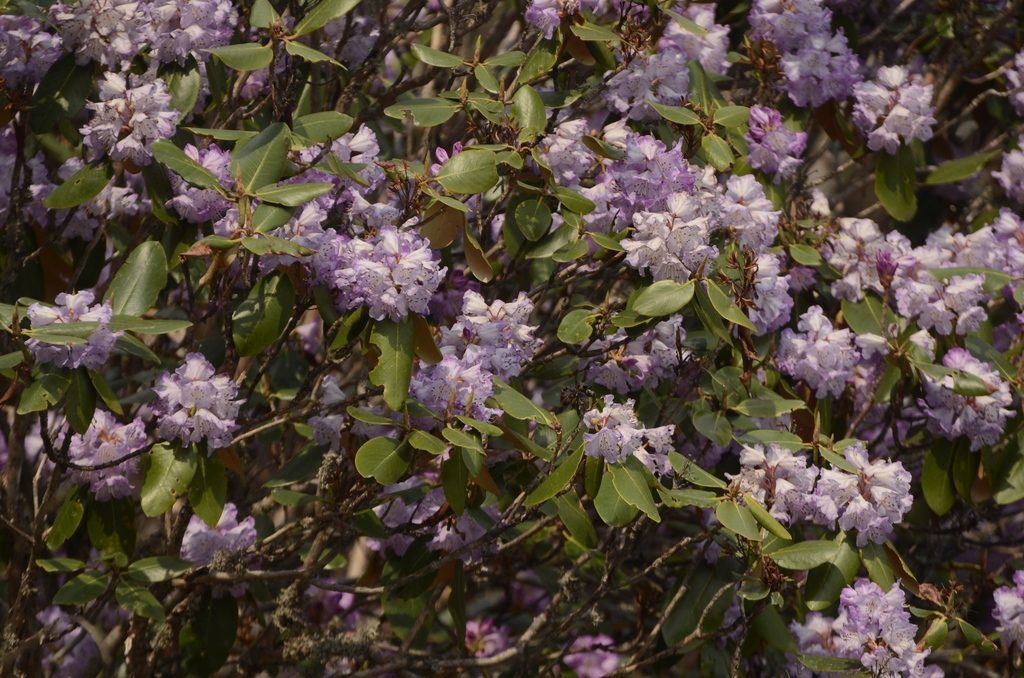
Rhododendron (Buras)
Rhododendron campanulatum
Recorded in the valleyBell-shaped lilac trusses on dense, shrubby slopes near the treeline.
Also known as: Buras (the Hindi and Garhwali name used for rhododendrons) · Simru (Garhwal name for this species, from one source) · Kashmiri patta (the traded leaf)
- Botanical name
- Rhododendron campanulatum
- Family
- Ericaceae
- Colour
- Lilac
- Bloom season
- June – July
- Altitude
- 3,000 – 4,400 m
Last checked 23 October 2026
Picking or uprooting any plant inside the national park is prohibited. Photograph, don’t pluck.
About Rhododendron (Buras)
Rhododendron campanulatum grows as a dense, shrubby thicket near the treeline, and in season its slopes turn lilac. The flowers are bell-shaped (campanulatum means bell-like) and held in rounded trusses, and the leathery leaves are felted brown or cinnamon on the underside.
It is a krummholz plant: a species whose stems are bent and twisted by snow and wind into low, impenetrable thickets at the upper edge of the forest. In Uttarakhand it covers timberline ground at about 3,000 to 4,400 m in almost every alpine zone, the Valley of Flowers among them. It flowers after the lower-altitude Rhododendron arboreum and R. barbatum.
To herders it is mostly useful for its wood: it burns even when wet, which matters in a place with so much rain. Ecologists track it because its thickets are moving upslope into the grass above them.
How to recognise it
A shrub up to a few metres tall with leathery, dark green leaves that are rusty-felted beneath, and bell-shaped lilac to pale pink flowers in tight trusses. Two smaller rhododendrons are also listed for the valley: the aromatic dwarf rhododendron (R. anthopogon), a low, scented shrub, and the scaly rhododendron (R. lepidotum), with small scaly leaves and open, saucer-shaped flowers.
Where and when it grows
The timberline and alpine zones of Uttarakhand at about 3,000 to 4,400 m. The botanical survey records lilac flowers in June and July.
Where to see it on the trek
This is a plant of the slopes above the meadow floor, not the meadow itself. It forms thickets, so the first sign is usually a band of dark, leathery shrubs along a slope or the edge of the forest. We could not find a published map of its thickets in the valley.
The survey records flowering in June and July, so visitors in the first weeks of the season have the best chance of lilac trusses. Later in the season the plants are still easy to spot as evergreen shrubs, but the flowers may be over.
See the route on the interactive trek map, and read Valley of Flowers altitude and altitude sickness before you go.
People and plants
An ethnobotanical review lists the wood as fuel, the flowers for food, medicine and ritual, and the leaves for fumigation. The leaves are traded as a raw drug under the name Kashmiri patta, and herders in Uttarakhand rely on the wood for firewood in the alpine zone. A field survey reports leaves used for rheumatism and sciatica, though that is not a peer-reviewed finding.
Good to know
- A 2025 study at three treeline sites in Garhwal (Tungnath, Bedni and Aali, at about 3,145 to 3,467 m) found krummholz stands of this species advancing by about 1.4 m a year, with the gaps between patches filling in with seedlings. That study was outside the valley, and shows what the species does at treeline, not what it does here.
- The same study found the plant's coldest, driest period is winter: snow cover can freeze the soil and block water uptake, while snowmelt keeps the soil moist through spring and summer until the monsoon.
A note of caution. Rhododendrons contain toxic compounds; do not eat any part of the plant.
How we know it grows here
Listed in the park's botanical checklist (lilac, June to July) and recorded by regional rhododendron surveys of Uttarakhand, including the Valley of Flowers.
Listed in the park's botanical checklist or photographed inside the valley.
Frequently asked questions
When does Rhododendron campanulatum bloom in the Valley of Flowers?
The park's botanical survey records lilac flowers in June and July, so the first weeks of the season are best.
How do I tell it from the other rhododendrons in the valley?
It is the tall, thicket-forming shrub with bell-shaped lilac flowers and rusty-felted leaves. The aromatic dwarf rhododendron is low and scented, and the scaly rhododendron has small scaly leaves.
What is a krummholz plant?
A shrub or tree bent into low, twisted thickets by snow and wind at the upper edge of the forest. This rhododendron is a typical example in the Himalaya.
Is the plant poisonous?
Rhododendrons contain toxic compounds, so do not eat any part of it.
What is it used for?
Mainly firewood, because it burns even when wet, plus fumigation, ritual and traditional medicine. The leaves are traded as Kashmiri patta.
Sources and how we wrote this
ValleyOfFlowers.in is an independent guide. This page summarises the park's botanical survey, published research and research-grade observation records, together with trekkers' public reports. Where sources disagree, we say so.
- Wadhwa, Rao & Hajra (1987), Botany of the Valley of Flowers National Park and its Environs, Bulletin of the Botanical Survey of India 29
- Rhododendron campanulatum – eFlora of India
- Ethnobotany of Rhododendron campanulatum (Ethnobotany Research & Applications)
- Seasonal dynamics and adaptation strategies of krummholz forming Rhododendron campanulatum (Singh et al. 2025, PLOS ONE)
- Rhododendrons in Uttarakhand: Diversity and Conservation
All photo credits
- (c) P Jeganathan, some rights reserved (CC BY) · via iNaturalist · Dharchula, Uttarakhand, India
- (c) Siddarth Machado, some rights reserved (CC BY) · via iNaturalist · East Sikkim, Sikkim, India
- (c) Jagdish Singh Negi, some rights reserved (CC BY) · via iNaturalist · Pithoragarh, Uttarakhand, India