More photos: Himalayan blue poppy in the gallery.
Himalayan Blue Poppy
Meconopsis aculeata
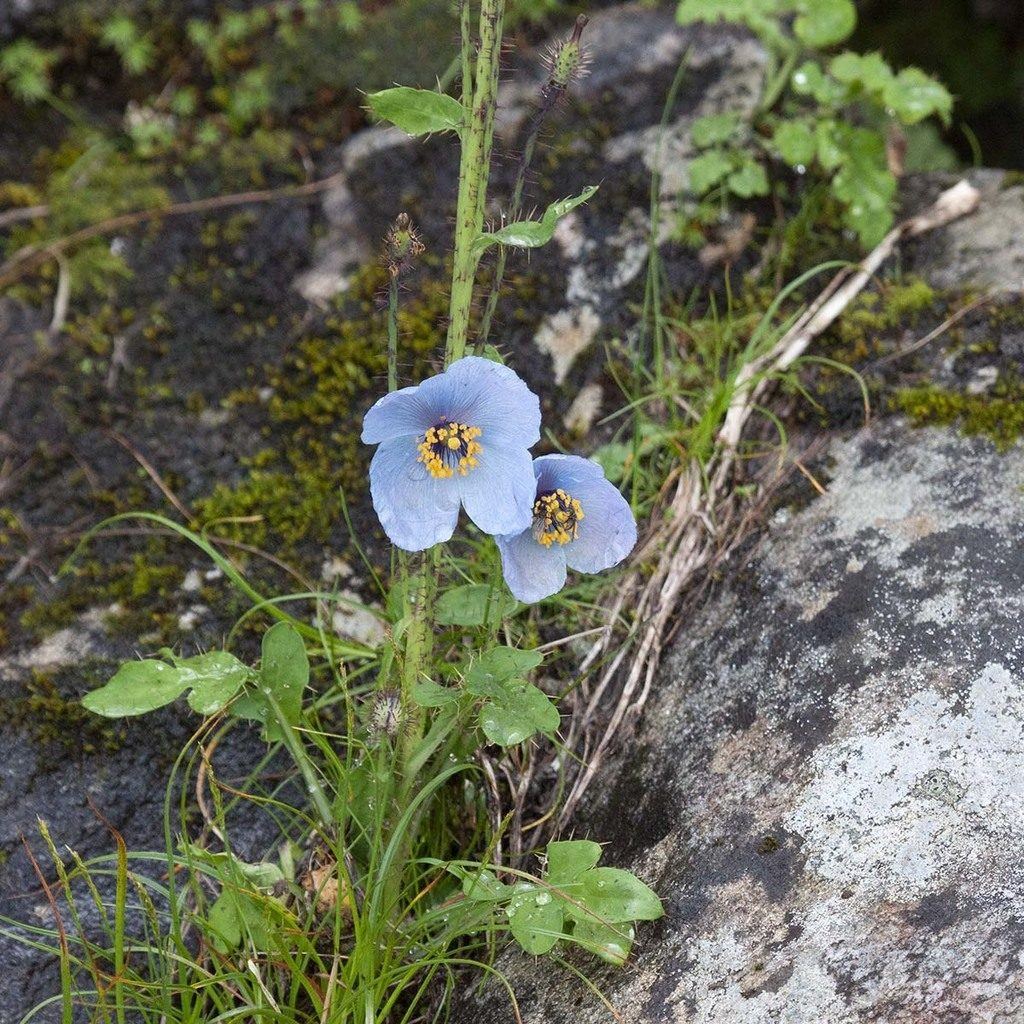
Recorded in the valleyThe valley's most famous bloom: sky-blue, papery petals around a golden boss of stamens, on bristly stems among rocks and boulders.
Also known as: Hindi: Vanita, Kanta (from eFlora of India, a single source) · Urdu: Gul-e-Nilam · Ladakh (Bhoti): Tsersnon
- Botanical name
- Meconopsis aculeata
- Family
- Papaveraceae
- Colour
- Sky blue
- Bloom season
- July – September
- Altitude
- 3,000 – 4,500 m
- Status
- Rare in the park
Last checked 18 October 2026
Picking or uprooting any plant inside the national park is prohibited. Photograph, don’t pluck.
About Himalayan Blue Poppy
Meconopsis aculeata is the flower most visitors hope to find: a sky-blue poppy with crinkled, paper-thin petals around a boss of golden stamens. It is a Himalayan endemic of the western Himalaya and south-west Tibet, and is usually described as monocarpic, meaning a plant flowers once and then dies, leaving seed to carry the population on.
Its fame outruns its abundance. The park's botanical survey lists it among the rare plants of the Valley of Flowers, and a study of the valley's changing vegetation noted that the blue poppy 'can hardly be seen now', naming the spread of Himalayan knotweed as the greatest danger to the valley's flora.
How to recognise it
Look for stiff, spiny bristles on stems and buds (aculeata means 'prickly') and fresh-green, deeply cut leaves. The nodding flowers have four crumpled sky-blue petals and a golden centre.
Where and when it grows
It grows among rocks, boulders and stony ledges in the alpine zone, roughly 3,000–4,500 m, and flowers from July into September. The botanical survey calls it common in the drier ground around Hemkund Lake, and trekkers on Reddit regularly say the best chance of seeing it is on the Hemkund Sahib route rather than on the valley floor. Sightings depend on year and weather, so treat it as a bonus.
Where to see it on the trek
Do not expect to find it on the valley floor. The Botanical Survey of India lists the blue poppy among the park's rare plants and describes it as common only on the drier, rocky ground around Hemkund lake. That matches what trekkers report: the climb to Hemkund Sahib, usually done the day after the valley, is where most people see it.
Look among boulders and on stony ledges beside the upper part of the Hemkund path and around the lake, from July into September. The flowers nod towards the ground, so look down at rock level rather than across the meadow, and expect only a few plants rather than a carpet.
The Hemkund climb gains about 1,100 m from Ghangaria, so go slowly and read our altitude guide before you set out. Stay on the path: a blue poppy flowers once and then dies, so every trampled seedling is a plant that never flowers.
See the climb on the interactive trek map (choose Hemkund Sahib), and read Valley of Flowers altitude and altitude sickness before you go.
What trekkers say
“Yes, hemkund sahib was quite beautiful than VoF. It had energy,it had blue poppy flower, brahmakamal and what not.”
People and plants
The plant is used in Tibetan-style (Sowa-Rigpa) medicine, and demand for it as medicine has put pressure on wild populations.
Conservation
A 2024 review in the Indian Forester describes it as an endangered and endemic medicinal plant of the Himalaya. Unsustainable harvest, habitat damage and climate change are the main threats named for it in the Himalaya.
Good to know
- It is one of nine plants in the survey's table of 'rare plants found in the Park'.
- Some visitor lists name another species, the Tibetan blue poppy (Meconopsis betonicifolia), but the park's botanical survey records only M. aculeata.
A note of caution. Photograph, don't pick. A plant that has flowered will not come back, and its seed is what keeps the population going.
How we know it grows here
Listed in the park's botanical checklist and in its rare-plants table. iNaturalist has 28 research-grade observations from the valley and Hemkund Sahib area (42 counting the Govindghat–Ghangaria trail).
Listed in the park's botanical checklist or photographed inside the valley.
Frequently asked questions
Where can I see the blue poppy in the Valley of Flowers?
Mostly on the rocky ground around Hemkund lake and beside the upper part of the Hemkund Sahib path, rather than on the valley floor. It is rare, so treat a sighting as a bonus.
When does the Himalayan blue poppy bloom?
From July into September, at roughly 3,000 to 4,500 m. Late July and August give the best chance.
Is it the Tibetan blue poppy?
No. The park's botanical survey records Meconopsis aculeata, the prickly Himalayan species. The Tibetan blue poppy, Meconopsis betonicifolia, is not recorded here, though some visitor lists name it.
Why is it called aculeata?
Aculeata means prickly, after the stiff bristles on its stems, leaves and buds. Look for them to tell it from other blue flowers.
Can I pick a blue poppy?
No. Picking any plant in the national park is prohibited, and this one flowers only once before it dies, so its seed matters.
Sources and how we wrote this
ValleyOfFlowers.in is an independent guide. This page summarises the park's botanical survey, published research and research-grade observation records, together with trekkers' public reports. Where sources disagree, we say so.
- Wadhwa, Rao & Hajra (1987), Botany of the Valley of Flowers National Park and its Environs, Bulletin of the Botanical Survey of India 29
- Meconopsis aculeata – Wikipedia
- Vanishing plant wealth of the Valley of Flowers
- Meconopsis aculeata Royle: an endangered and endemic medicinal plant in the Himalaya (Indian Forester)
- eFlora of India: Meconopsis aculeata
All photo credits
- (c) Paulmathi Vinod, some rights reserved (CC BY) · via iNaturalist · Uttarakhand 246443, India
- (c) Siddarth Machado, some rights reserved (CC BY) · via iNaturalist · Uttarakhand 246443, India
- no rights reserved · via iNaturalist · Garhwal Division, Uttarakhand, India