Wallich's Milk Parsley
Ligusticopsis wallichiana
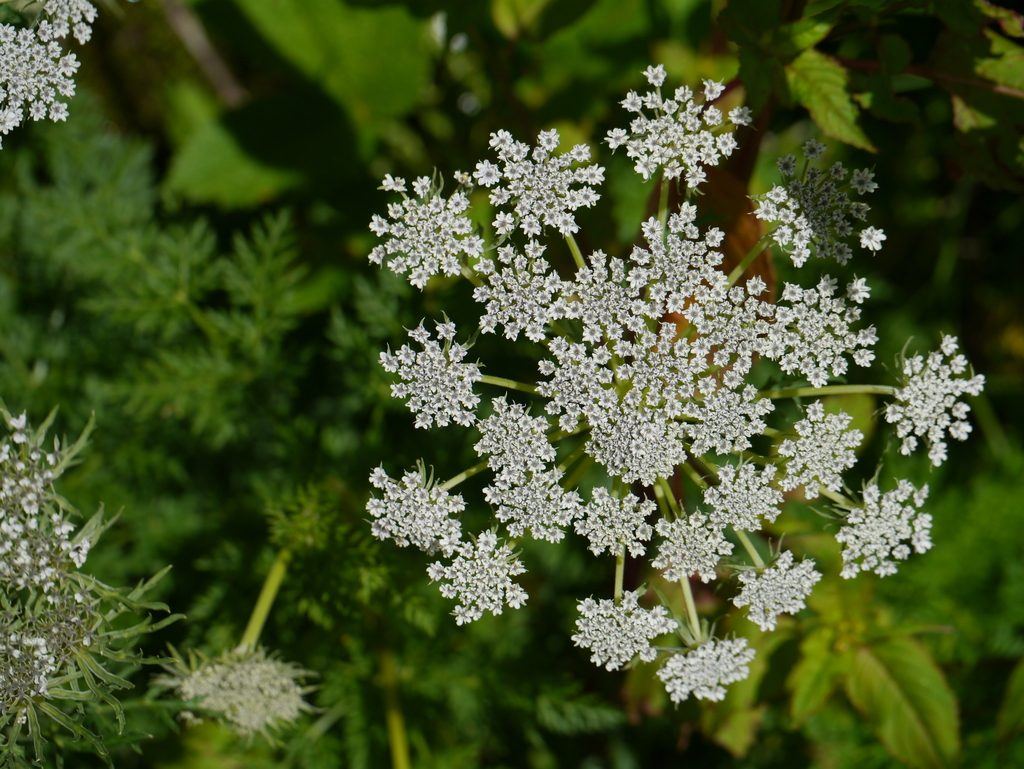
Recorded in the valleyLacy white umbels like Queen Anne's lace, filling the meadow edges.
Also known as: Wallich's milk parsley · Ligusticopsis wallichiana (current name) · Selinum wallichianum (older name) · Bhutkeshi (Kumaoni, 'ghost's hair')
- Botanical name
- Ligusticopsis wallichiana
- Family
- Apiaceae
- Colour
- White
- Bloom season
- July – September
- Altitude
- 2,700 – 4,000 m
Last checked 23 October 2026
Picking or uprooting any plant inside the national park is prohibited. Photograph, don’t pluck.
About Wallich's Milk Parsley
A tall, lacy umbellifer whose flat umbels of white flowers float over fern-like leaves. A plant can reach about 1 to 1.8 m and carries thousands of tiny five-petalled flowers in each umbel. It is a favourite with garden designers, and its name honours the Danish botanist Nathaniel Wallich.
In Kumaon the plant's Bhutkeshi name, meaning ghost's hair, refers to the dark fibres from old leaf bases that ring the top of the root. These were traditionally used to ward off evil spirits called bhuts, and the dried root is traded locally under that name.
The plant has had a confusing life on paper. Its current accepted name is Ligusticopsis wallichiana, but gardeners still sell it as Selinum wallichianum, which is the name in the park's 1987 botanical survey. It has been given more than a dozen synonyms, so older papers can be hard to match.
How to recognise it
Finely divided, fern-like basal leaves, tall, branched stems that are often flushed red or purple, and large, flat, lacy white umbels. The leaves are thin, which gave the plant one of its former names, tenuifolium, meaning thin-leaved. Many white umbellifers look alike, so check the leaves and the red-flushed stems.
Where and when it grows
Open slopes, and among shrubs, from about 2,700 to 4,000 m. It flowers from midsummer into early autumn, so it is a plant for the later part of the season.
Where to see it on the trek
The plant's altitude range, about 2,700 to 4,000 m, takes in Ghangaria (about 3,050 m) and the valley meadows. Look at the meadow edges and open slopes, where the umbels stand above the lower flowers.
It is rarely recorded: iNaturalist holds only two research-grade observations from the valley and Hemkund area, so we cannot name a reliable spot. Do not expect to find it on demand.
The umbels are easy to mistake for other white umbellifers, so photograph the leaf and the stem as well as the flower head.
See the route on the interactive trek map, and read Valley of Flowers altitude and altitude sickness before you go.
People and plants
The dried root is traded under the name Bhutkeshi. The whole plant features in traditional magico-religious practice in the Himalaya, where it is used to prepare dhoop (incense), and the powdered root is used as a fumigant in some rituals. The 'seeds' (really fruits) and roots are reported in traditional medicine for rheumatism, kidney disease and abdominal pain, but those are traditional claims and we found no clinical evidence. In Ayurveda, Bhootkeshi can also mean a different plant, Selinum vaginatum, used as a substitute for jatamansi.
Good to know
- Like many in the carrot family, the plant is aromatic, particularly the root.
- The 1987 botanical survey lists both Selinum wallichianum and Selinum vaginatum for the park, which is why the herb trade's Bhootkeshi is easy to confuse with this plant.
- In gardens it is grown as a hardy ornamental for mixed borders, valued for its tiered umbels.
A note of caution. Never taste a wild umbellifer. The family includes some highly poisonous plants that look similar, and the traditional uses of this one are not tested.
How we know it grows here
Listed in the park's botanical checklist (as Selinum wallichianum and S. vaginatum). iNaturalist has 2 research-grade observations from the valley and Hemkund Sahib area (3 counting the Govindghat–Ghangaria trail).
Listed in the park's botanical checklist or photographed inside the valley.
Frequently asked questions
Is Selinum the same as Ligusticopsis wallichiana?
Yes. Selinum wallichianum is the older name; the accepted name today is Ligusticopsis wallichiana. The park's 1987 survey uses the older one.
What does Bhutkeshi mean?
Ghost's hair, in Kumaoni. It refers to the dark fibres from old leaf bases around the top of the root, traditionally used to ward off bhuts.
When does it flower?
From midsummer into early autumn, which is roughly July to September in the valley.
How tall is it?
About 1 to 1.8 m, with umbels of thousands of tiny white flowers.
Is Bhootkeshi the same plant as jatamansi?
No. In Ayurveda the name Bhootkeshi can mean Selinum vaginatum, which is used as a substitute for jatamansi. Jatamansi itself is a different plant.
Sources and how we wrote this
ValleyOfFlowers.in is an independent guide. This page summarises the park's botanical survey, published research and research-grade observation records, together with trekkers' public reports. Where sources disagree, we say so.
All photo credits
- (c) Dinesh Valke, some rights reserved (CC BY-SA) · via iNaturalist · , Uttarakhand, India
- (c) Dinesh Valke, some rights reserved (CC BY-SA) · via iNaturalist · , Uttarakhand, India
- (c) Dinesh Valke, some rights reserved (CC BY-SA) · via iNaturalist · , Uttarakhand, India