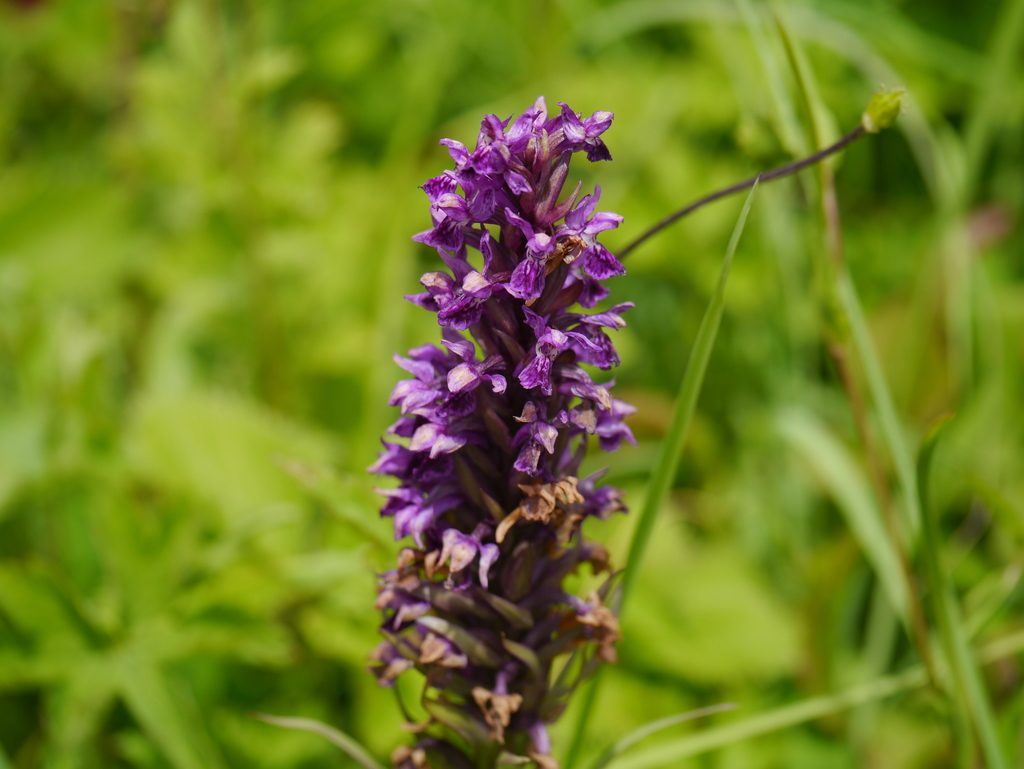
Himalayan Marsh Orchid (Salam Panja)
Dactylorhiza hatagirea
Recorded in the valleyA terrestrial orchid with dense purple spikes and hand-shaped tubers, heavily collected for salep.
Also known as: Hatajari, Hatpanja (Uttarakhand) · Panchaule (Nepal) · Salam panja (Kashmir) · Wanglak, Angulagpa (Ladakh)
- Botanical name
- Dactylorhiza hatagirea
- Family
- Orchidaceae
- Colour
- Purple
- Bloom season
- June – August
- Altitude
- 2,500 – 4,200 m
- Status
- Critically endangered · CITES II
Last checked 23 October 2026
Picking or uprooting any plant inside the national park is prohibited. Photograph, don’t pluck.
About Himalayan Marsh Orchid (Salam Panja)
Dactylorhiza hatagirea is the valley's orchid with the most pressure on it. The flower is a dense spike of purple to pink blossoms on a plant about 20 to 50 cm tall, but its value to collectors is underground: hand-shaped tubers with finger-like lobes, which give it the name salam panja. The Great Himalayan National Park glosses panja as a claw or palm.
Those tubers are dug up to make salep, a starchy product eaten as food and drink and used in Ayurvedic and Unani medicine. A 2021 study lists uses against diabetes, dysentery, colic and diarrhoea and as an aphrodisiac, and a review notes traditional use for circulatory, respiratory, nervous, digestive and reproductive complaints. We have not checked those claims and do not repeat them as medical advice.
A plant that is dug up does not come back. Because the tuber is the part that is sold, harvesting it kills the plant, and that is why the species is now protected on paper in several countries.
How to recognise it
A leafy stem with long, narrow leaves in a basal rosette, topped with a dense cylinder of purple to pink-violet flowers. The bracts under the flowers are longer than the flowers themselves, which gives the spike a leafy look. The Himalayan fragrant orchid, Gymnadenia orchidis, looks similar but has scented, more slender spikes.
Where and when it grows
Damp grassy meadows and open slopes in the sub-alpine and alpine zones, at roughly 2,500 to 4,200 m; the Great Himalayan National Park and a Nepal habitat study both give 2,800 to 4,200 m, and some sources say higher. It flowers June to August. A cultivation guide for Uttarakhand lists the Valley of Flowers among its sites, and the park's botanical survey lists it among the rare plants.
Where to see it on the trek
Expect to look hard. iNaturalist holds only three research-grade records from the valley area, and exact locations of threatened plants may be hidden there, so we cannot point you to a spot. It grows in damp, grassy ground rather than on rock, so scan the wetter meadow patches and not the boulder slopes.
The park's survey records it in flower in June and general sources say June to August, so by the main July to September season many spikes may already have gone over. A purple spike in late season may be a different plant, so check the leaves and the long bracts before you decide.
If you find one, photograph it from the path and leave the ground around it untouched.
See the route on the interactive trek map, and read Valley of Flowers altitude and altitude sickness before you go.
People and plants
Collected for salep and for Ayurvedic and Unani preparations. The Great Himalayan National Park lists it as an ingredient of many such preparations and says collection there is now heavily restricted.
Conservation
Listed in CITES Appendix II. A 2021 paper calls it threatened (IUCN) and critically endangered (CAMP), and it is strictly protected in Nepal, where collection and trade of the rhizome are banned. Over-collection, illegal trade, grazing and habitat loss are the pressures named. A modelling study expects climate change to push its suitable habitat to higher altitudes, with severe losses in Nepal by 2050 and 2070. Efforts so far include mass propagation away from the wild and reintroduction.
Good to know
- The park's botanical survey lists it in its table of rare plants found in the park.
- Two orchids with purple spikes are listed for the valley: this one and the Himalayan fragrant orchid (Gymnadenia orchidis), which has scented, more slender spikes.
A note of caution. Never dig up an orchid. It is a legal offence in the national park, and orchids rarely survive transplanting.
How we know it grows here
Listed in the park's botanical checklist and in its rare-plants table (purple, June). iNaturalist has 3 research-grade observations from the valley and Hemkund Sahib area. Its exact locations may be hidden by iNaturalist.
Listed in the park's botanical checklist or photographed inside the valley.
Frequently asked questions
What is salam panja?
The common name of Dactylorhiza hatagirea, a purple-flowered orchid whose hand-shaped tubers are collected to make salep and for traditional medicine.
When does the Himalayan marsh orchid flower?
June to August across its range. The park's botanical survey records it in flower in June.
Where can I see it in the Valley of Flowers?
In damp, grassy meadow ground in the alpine zone. It is rarely recorded, so a sighting is a bonus, not something to plan around.
Is it legal to collect salam panja?
No. It is listed in CITES Appendix II, picking any plant in the national park is prohibited, and Nepal bans collection and trade of the rhizome.
Why is it endangered?
The tuber is the part that is sold, so harvesting kills the plant. Illegal trade, grazing and habitat loss add to the pressure, and models expect warming to shrink its suitable habitat.
Sources and how we wrote this
ValleyOfFlowers.in is an independent guide. This page summarises the park's botanical survey, published research and research-grade observation records, together with trekkers' public reports. Where sources disagree, we say so.
- Wadhwa, Rao & Hajra (1987), Botany of the Valley of Flowers National Park and its Environs, Bulletin of the Botanical Survey of India 29
- Dactylorhiza hatagirea – ENVIS FRLHT
- Salam panja – Great Himalayan National Park
- Suitability of habitats in Nepal for Dactylorhiza hatagirea now and under predicted future climate (Shrestha et al. 2021, Plants)
All photo credits
- (c) Dinesh Valke, some rights reserved (CC BY-SA) · via iNaturalist · , Uttarakhand, India
- (c) Siddarth Machado, some rights reserved (CC BY) · via iNaturalist · Uttarakhand 246443, India
- (c) Wang.QG, some rights reserved (CC BY) · via iNaturalist · 中国西藏自治区林芝市米林县