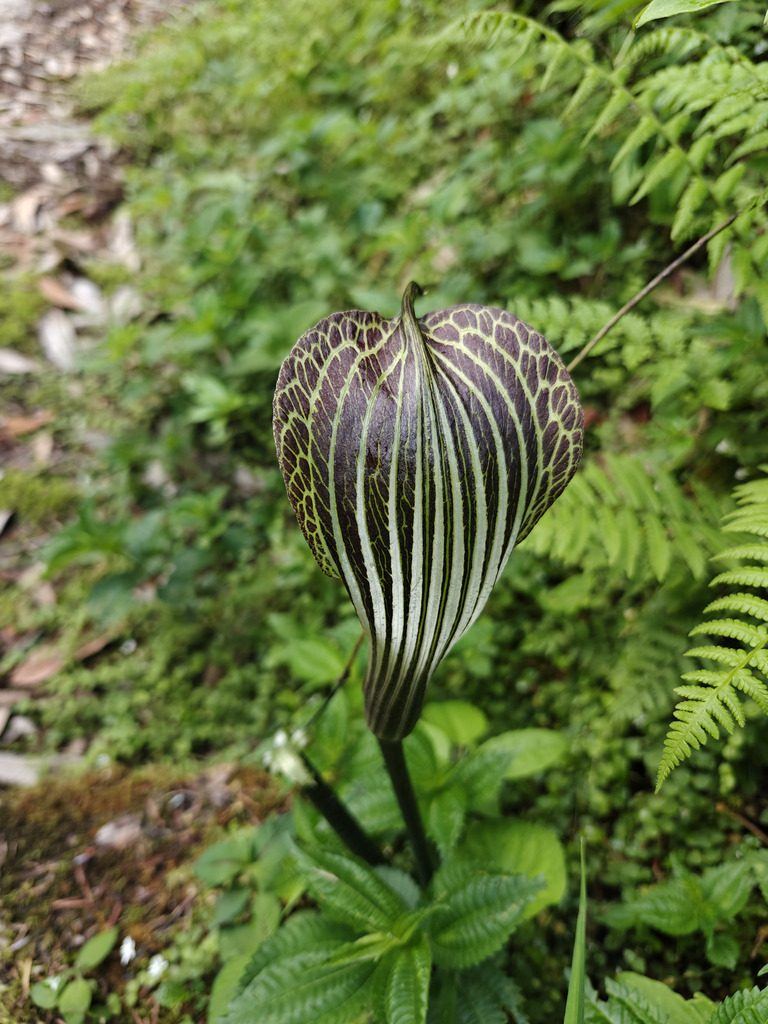
Cobra Lily
Arisaema propinquum
Recorded in the valleyA hooded, striped spathe that looks like a rising cobra, found in shaded, moist ground along the trail from Govindghat to Ghangaria.
Also known as: Wallich's cobra lily · Himalayan cobra lily
- Botanical name
- Arisaema propinquum
- Family
- Araceae
- Colour
- Purple-brown
- Bloom season
- June – August
- Altitude
- 2,400 – 3,600 m
Last checked 23 October 2026
Picking or uprooting any plant inside the national park is prohibited. Photograph, don’t pluck.
About Cobra Lily
The cobra lilies are among the oddest plants of the trail. What looks like a single flower is a hooded tube, the spathe, wrapped around a club-like spike, the spadix, that carries the real, tiny flowers. In Arisaema propinquum the hood is dark purple, striped with white or purple, and ends in a narrow, tail-like tip a few centimetres long. It tilts forward like the head of a rearing snake, which is where the common name comes from.
It is a Himalayan plant, recorded from Kashmir to south-east Tibet at about 2,400 to 3,600 m. A plant grows up to about 30 cm tall, with one or two very large, three-lobed, yellowish-green leaves, and the leaf stalk and stem are often spotted with brown.
After flowering, the spike swells into a club of berries that turn red in autumn. By then the hood has withered, so a plant can look like a different species from one month to the next.
How to recognise it
Look for one or two big, three-lobed leaves on a brown-spotted stalk and, beside them, a dark purple hood with pale stripes and a pointed tip. Out of flower the plant is easy to miss in the undergrowth. Two other cobra lilies are listed for the valley: Jacquemont's (A. jacquemontii), with a green, white-striped hood and leaves split into five to seven leaflets, and the whipcord cobra lily (A. tortuosum), named for the long whip-like tail of its hood and found lower down.
Where and when it grows
Shaded, moist ground such as forest edges and stream sides, at roughly 2,400 to 3,600 m. The park's botanical survey records purple-brown flowers from June to August, while other floras give May to June, so timing shifts with altitude and with how early the snow melts.
Where to see it on the trek
Look low and in shade, not out in the open meadows. Cobra lilies like damp woods and streamsides, and their altitude range takes in the approach to Ghangaria (about 3,050 m) and the lower edge of the valley. We could not find a published record that names a particular spot, so treat this as guidance on habitat, not a map.
The hood is dark and often half-hidden by the leaf, so most walkers pass it. Scan damp ground beside the trail and look under the big leaves. Sources disagree on when it flowers, so some hoods may be over by the main July to September season; look instead for the swelling spike of berries.
Do not touch the plant to get a better photograph, and keep children and dogs away from it.
See the route on the interactive trek map, and read Valley of Flowers altitude and altitude sickness before you go.
People and plants
Arisaema tubers are rich in calcium oxalate crystals, which irritate the mouth and skin, and cobra lilies are generally treated as toxic. We found no solid evidence for use of this particular species by people.
Good to know
- Cobra lilies are pollinated by fungus gnats lured into the hood. A 2020 study of five Arisaema species in Japan found that the waxy inner surface makes visitors slip to the bottom. In male plants the gnats escape through a hole at the base carrying pollen; in female plants there is no exit, so the gnats move about the spadix, leave pollen on the stigma and die. That work was on other species in another country; we found no pollination study of this one.
- Plants in the genus can change sex from year to year depending on their size and energy reserves. This is a general trait of Arisaema and has not been tested on this species here.
A note of caution. Do not touch your mouth or eyes after handling any part of an Arisaema plant, and never taste the berries or roots.
How we know it grows here
Listed in the park's botanical checklist (flowering June to August, purple-brown). iNaturalist has only a handful of records from Uttarakhand, so we could not map it more closely.
Listed in the park's botanical checklist or photographed inside the valley.
Frequently asked questions
What is the cobra lily?
A plant of the arum family whose flower is a hooded tube that tilts forward like a rearing cobra. In Arisaema propinquum the hood is dark purple with pale stripes and a tail-like tip.
When does the cobra lily flower in the Valley of Flowers?
The park's botanical survey gives June to August; other floras say May to June. By the main July to September season the hood may be over and the berries forming.
Where do I look for it?
In damp, shaded ground such as forest edges and stream sides, between about 2,400 and 3,600 m. It is not a plant of the open meadows.
Is the cobra lily poisonous?
Treat it as toxic. Arisaema tubers contain calcium oxalate crystals that irritate the mouth and skin, so do not eat any part of it.
Why is it called a cobra lily?
The striped hood rises and tilts forward like the head of a rearing snake. It is not a true lily.
Sources and how we wrote this
ValleyOfFlowers.in is an independent guide. This page summarises the park's botanical survey, published research and research-grade observation records, together with trekkers' public reports. Where sources disagree, we say so.
- Wadhwa, Rao & Hajra (1987), Botany of the Valley of Flowers National Park and its Environs, Bulletin of the Botanical Survey of India 29
- Arisaema propinquum – Wikipedia
- eFlora of India: Arisaema propinquum
- Selective pollination by fungus gnats among five Arisaema species (Matsumoto et al. 2020, Annals of Botany)
- Botanical Survey of India chromosome data: Arisaema propinquum
All photo credits
- (c) Jiao Sun (孙娇), some rights reserved (CC BY) · via iNaturalist · 中国西藏自治区日喀则市聂拉木县
- (c) T R Shankar Raman, some rights reserved (CC BY) · via iNaturalist · Dehradun, IN-UT, IN
- (c) T R Shankar Raman, some rights reserved (CC BY) · via iNaturalist · Dehradun, IN-UT, IN