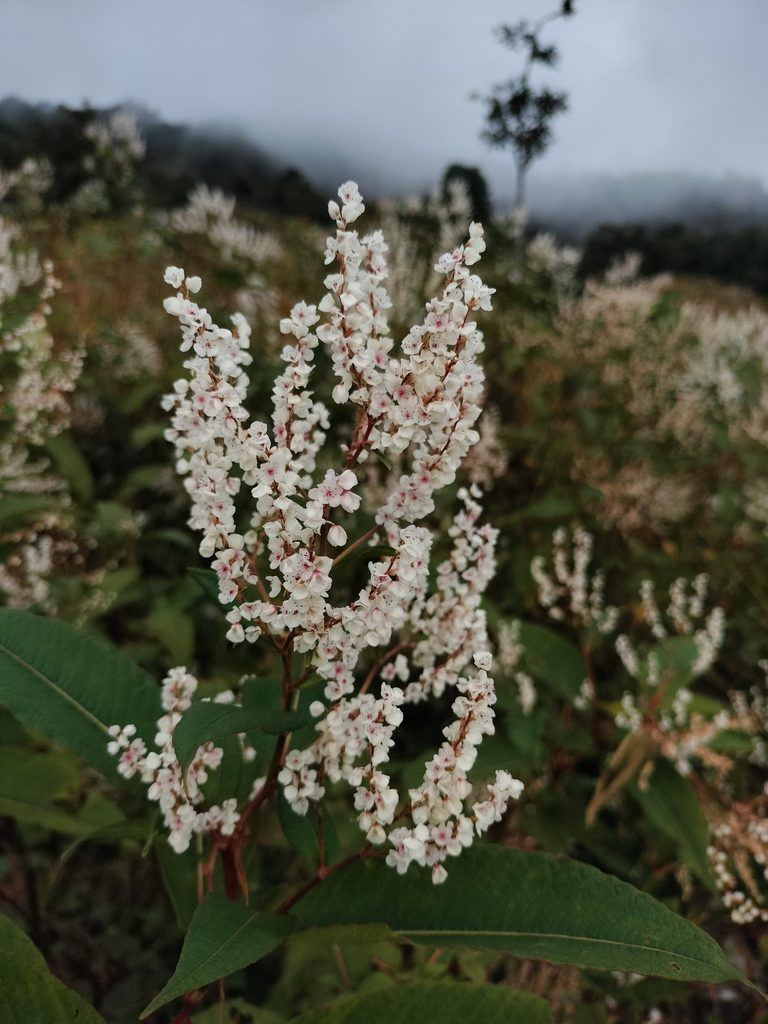
Himalayan Knotweed
Koenigia polystachya
Recorded in the valleyTall frothy plumes of white flowers. A native plant, but now spreading aggressively through the valley.
Also known as: Koenigia polystachya · Polygonum polystachyum, Aconogonum polystachyum, Persicaria wallichii (older names) · Formerly listed on this site as 'Mountain Knotweed'
- Botanical name
- Koenigia polystachya
- Family
- Polygonaceae
- Colour
- Creamy white
- Bloom season
- August – September
- Altitude
- 2,400 – 4,000 m
- Status
- Invasive in the valley
Last checked 23 October 2026
Picking or uprooting any plant inside the national park is prohibited. Photograph, don’t pluck.
About Himalayan Knotweed
This is the plant the Valley of Flowers' botanists worry about most. Himalayan knotweed is a native Himalayan species, with tall stems and plumes of creamy white flowers in late summer, but within the valley it has been spreading at the expense of other plants. The 2025 IUCN World Heritage Outlook for the park describes it as a native but aggressive colonizer, often acting as a local invader.
A 2015 to 2018 monitoring study of the national park and nearby sites compared patches with and without the plant. Where it was present, the number of species fell year by year while its own density and abundance rose. An earlier survey called its rapid increase 'the greatest danger which the valley is facing' and noted that some species recorded in earlier decades had vanished.
It is not simply a visitor problem or a grazing problem, and the research disagrees on the cure. That is what makes it worth reading about before you walk the valley.
How to recognise it
Waist- to shoulder-high stems with big, pointed, almost sandpapery leaves, and large branched plumes of small, creamy white flowers from August. It forms dense stands that crowd out smaller flowers. It spreads by thick rhizomes as well as by seed.
Where and when it grows
Reported from about 2,400 to 4,000 m, flowering August to September. A 2004 survey of the valley found its highest density between 3,300 and 3,500 m, on disturbed ground: bouldery areas, the fragmented treeline zone, avalanche-prone ground and eroded slopes. A 2022 study found it up to 4,200 m, compared with 3,800 m earlier.
Where to see it on the trek
You do not have to look for it. On the valley floor, between about 3,200 and 3,500 m, the tall white plumes line the path, because a 2022 study found the densest invasive stands within about 25 m of the trail, while undisturbed ground away from paths had none.
The same study found that trampling compacts the soil, which suits a plant that spreads by thick rhizomes. So the most useful thing a visitor can do is stay on the path and not shortcut across the meadow.
It flowers in August and September, so you will meet it at the busiest time. Visitor numbers to the valley rose continuously between 2010 and 2017, with a peak in August and September.
See the route on the interactive trek map, and read Valley of Flowers altitude and altitude sickness before you go.
People and plants
No use of note; in gardens it is grown as a tall ornamental.
Conservation
It is a native plant behaving aggressively, which makes management hard, and the studies disagree on what to do. A 2004 study found that eradicating it from the park would not help long-term conservation and could cause soil erosion and instability, and it studied the conflict between the ban on grazing and the herders affected by it. A 2022 study found that removing the knotweed by hand increased the density of another fast-growing plant, the balsam Impatiens sulcata, and advised against a complete ban on migratory grazing. Outside India, the same plant is regulated: the EU lists it among invasive alien species of concern, and California treats it as a noxious weed. The IUCN outlook rates the park's overall conservation outlook 'Good with some concerns'.
Good to know
- It has been called by many names over the years: Koenigia polystachya, Polygonum polystachyum, Aconogonum polystachyum and Persicaria wallichii all refer to it.
- Along with Impatiens balsams, knotweeds are the plants a 2013 foreword singled out as invading the valley.
- The 2022 study also recorded the parasitic plant dodder (Cuscuta europaea) on disturbed ground in the valley, and found no invasive species in any undisturbed site.
How we know it grows here
Recorded widely in the valley: iNaturalist has about 30 research-grade observations in the valley and trek area, and several studies followed the plant's spread inside the park.
Listed in the park's botanical checklist or photographed inside the valley.
Frequently asked questions
Is Himalayan knotweed native to the Valley of Flowers?
Yes, it is a native Himalayan plant. It is considered a problem because it spreads aggressively and crowds out other species, so researchers call it a native colonizer that acts like an invader.
Why is it a problem?
Monitoring found that species richness fell year by year in invaded patches while the knotweed's own density rose. An earlier survey called it the greatest danger the valley faces.
Where will I see it?
Mostly beside the path on the valley floor, between about 3,200 and 3,500 m, where a 2022 study found the densest invasive stands. It flowers in August and September.
Can it be removed?
It is disputed. A 2004 study warned that eradication could cause soil erosion, and a 2022 study found that removing it by hand boosted another weed, Impatiens sulcata.
What can visitors do?
Stay on the path, do not shortcut across the meadow, and do not pick plants. Trampled, compacted ground is where the plant gains ground.
Sources and how we wrote this
ValleyOfFlowers.in is an independent guide. This page summarises the park's botanical survey, published research and research-grade observation records, together with trekkers' public reports. Where sources disagree, we say so.
- Vanishing plant wealth of the Valley of Flowers
- Pastoralism, plant conservation, and conflicts on proliferation of Himalayan knotweed (Kala 2004, Biodiversity and Conservation)
- Influence of anthropogenic pressure on plant species richness in Indian Himalayan high-altitude protected areas (Bisht et al. 2022, Frontiers in Ecology and Evolution)
- Nanda Devi and Valley of Flowers National Parks – IUCN World Heritage Outlook
- Valley of weeds (India Environment Portal)
- Koenigia polystachya – Wikipedia
- Koenigia polystachya – EPPO Global Database
All photo credits
- (c) Jagdish Singh Negi, some rights reserved (CC BY) · via iNaturalist · 36CP+JW4, Munsyari, Uttarakhand 262554, India
- (c) Hopeland, some rights reserved (CC BY) · via iNaturalist · Pithoragarh, IN-UT, IN
- (c) Karen Soacha, some rights reserved (CC BY) · via iNaturalist · mana bhim pul, NH 58, Mana, Uttarakhand 246422, India